Stockholm - a workcation in Autumn
A work-meets-play autumn break in Stockholm. How we enjoyed a workcation trip amidst falling leaves and the last of the long days for the year.
Itinerary at a glance
5 day independent itinerary for Stockholm, based on flying in and out of Leeds in October
Highlights include mushroom foraging experience, golden sun slanting through golden leaves, baked goods, an ice hockey game and an in-depth look at the female founder of Svenskt Tenn, Estrid Ericson.
Based on a couple travelling, with a focus on leisurely outdoor and cultural activities, interspersed with time to just relax and soak up the atmosphere
Honest verdict
Did I enjoy the holiday? Does the place live up to expectations?
Just like our last trip to Sweden, Stockholm exceeded our expectations. Compared to London, and in fact, the overall busy-ness of the UK, it is hard to credit that Stockholm is the capital city. So chilled. None of that pavement overcrowding nonsense. No wrestling to enter or exit the metro. Hardly a queue anywhere. Such a relaxing city, and a relaxed place to spend a few days. The nature and water is also everywhere, which adds to the tranquility.
Did the itinerary work for the trip?
Absolutely. We are experimenting with workcation formats, and this one worked. Getting to extend a city break by a few working days whilst there really lets us slip into the vibe of the city and get to know it far better than can be managed on 2 or 3 short and packed days.
Would I make another visit?
Would I…………..we could live in Sweden. Would love to see the city in both winter and spring, however, there isn’t the same volume of things to do in Stockholm as compared to some of Europe’s other capitals, so my suggestion would be to plan itinerary with 2 or 3 days’ worth of sightseeing, which will have you see a good chunk. It would be a great stop point for a longer road trip around Sweden.
WHEN
Mid-October
Autumn foliage
Cool to cold, bright golden sunshine (just as likely to get wet and grey)
TRAVEL MEANS
KLM, from Leeds, changing in Amsterdam
Fast train from the airport to the city centre. Throughout the city, we relied on walking and a little of the underground.
ACCOMMODATION
We stayed in this Airbnb
SCHEDULE
Day 1 - Tuesday
Travel in the morning
Settle in
Grocery shopping & Late Lunch - Östermalms Saluhall
Day 2 - Wednesday
Work
Svenskt Tenn exhibition “ A Philosophy of Home”
Evening ice-hockey game - Ice hockey is probably the team sport most closely associated with Sweden, with the most prominent clubs in Stockholm being Djurgården and AIK. The ice hockey season starts in September and lasts to March and Stockholm has a couple of notable ice hockey rinks:
Hovet: Originally known as Johanneshovs Isstadion, Hovet is one of Stockholm’s oldest and most iconic ice hockey arenas and is home to AIK Hockey and Djurgården Hockey.
Avicii Arena: Previously known as the Ericsson Globe and Stockholm Globe Arena, this arena is commonly referred to as “Globen” in Swedish. It is a major venue for ice hockey, concerts, and other events. Closed for modernisation until 2025
Book tickets here
Day 3 - Thursday
Work
Day 4 - Friday
Wandered Stockholm on foot
VasaMuseet - home of a 17th century warship
Prince Eugen’s art collection at Waldermarsudde - Since 1948, Waldemarsudde has been open to the public, allowing visitors to explore Prince Eugen’s extensive art collection and his beautifully preserved home. Obligatory cafe on site. Closed Mondays, late night opening Thursdays until 8pm
Evening Meal at Meatballs For the People - delish, and highly unusual. Had the Elk meatballs against a backdrop of Y2K RnB party choons. Class.
Day 5 - Saturday
Day 6 -Sunday
Breakfast at Stora Bageriet - Just around the corner from The Royal Dramatic Theatre is the entrance to the bakery where breakfast and light lunch is served. We first went on another day and there was a queue out the door………….when we returned on our final morning, arriving just after 8am, we knew why. Had the most delicious Salted Vanilla roll………….
Travel home
Ideas for another visit
-
Stay a couple of days on Grinda Island in summer - accessible from Stockholm by a 1 hour fast boat from Vaxholm, this island is the home of a traditional inn, where you can relax and enjoy the archipelago’s slow pace of life for a few days
-
The light festival in Brunnsviken - Join locals in early November, to take part in a procession of lit torches to bring illumination to the start of the dark season
Stockholm Jazz Festival - Happens annually, in the middle of October
Walking Tour - https://www.viator.com/tours/Stockholm/Unique-walking-tour/d907-73361P1
Ghost Walk - runs 4:30pm to 6:00pm most days. Options in Gamla Stan or Sodermalm
Guided tours of the Riksdag (Swedish Parliament) - Each day between September and June there are free tours for 28 people. The tours are in English and start at 1:30pm
-
Kanelbullens dag (Cinnamon Bun Day) is celebrated on October 4th each year.
September Sunset at Restaurang Slipen - If you prefer a sundowner to breakfast, at Slipen, you can also sit by the jetty in the early evenings and have a glass of wine and look out over the water while the sun sets over Beckholmen. In my view, September is the month for sunset’s in northern Europe, with the sun starting to dip and paint the sky with colour around 7:50pm in early-September up to 6:25pm in late-September
Other October Itineraries
Chokoladbiskvier
Recipe for Chokoladbiskvier, or Swedish Chocolate Buttercream Macaroons. Alcohol optional. Ideal for making at any time of the year.
Swedish Chocolate Buttercream Macaroons
When we visited Sweden, we took a marvellous hike-with-outdoor-cooking with Anders, just outside of Halmstad. Part of the spread Anders brought included some mini baked treats, which were utterly delicious, and he told me they had been baked by his wife, Viktoria.
I was quizzing him with all sorts of questions about the baking and assume he must have decided that I needed to hear it from the horse’s mouth, and a few days after our hike, completely unexpectedly, they very kindly invited us for fika at their home in Halmstad.
The day was balmy. We sat outside under a tree, at a small table covered with a white tablecloth with the corners held down by clip-on cloth weights in the shape of a Dalarna Horse, and Viktoria served 6 types of bitesize fika, all baked by her own hands.
The classic Biskvi was my favourite of Viktoria’s treats, and she was further kind enough to share the recipe with me, which is what I have used to make these.
I’d say they are pretty close to what we had that day, though I would advise anyone to do a test run in your oven with a few of the bases at a time, to check your own oven’s bake time - these can easily overbake.
PORTION SIZE
Makes about 25-28 macaroons
TOOLS
Other than the typical kitchen equipment, to make these, you need:
a blender or food processor
an electric whisk
a baking sheet or a shallow roasting tin, 3-4cm deep
a cooling rack
INGREDIENTS
Base
275g skinless almonds or ground almonds
135g caster sugar
2 large egg whites (about 80g)
Buttercream
250g salted butter, softened (or half salted & half unsalted)
135g caster, vanilla or icing sugar
2 egg yolks
3 tbsp rum, cognac or brandy (about 60ml - optional)
Chocolate enrobing
150g semi-sweet dark chocolate (45-60% cocoa solids)
20g coconut oil
METHOD
Prep almonds - If you are using whole skinless almonds, finely grind them in a food processor first. Transfer the ground almonds with the sugar to a large bowl and whisk to fully combine.
Make dough for bases - In a separate bowl, whisk the egg whites until soft peaks form, and then mix in the dry ingredients. You should have a very thick paste, almost like marzipan.
Prep bases for baking - Line a baking sheet with reusable paper. Weight out 17-18g of the mixture, roll into a ball between palms and then flatten slightly into a disc, approx. 4cm in diameter. Space about 4cm apart on the baking sheet – they don’t spread at all during baking. Let them stand for about 30 minutes at room temperature.
**************** WAIT 30 MINS ****************
Prep oven - Heat the oven to 160°C fan, 180°C regular.
Bake - Bake in the centre of the oven for 12-15 minutes. They should be lightly tinged gold just at the edges when done (if bronzed all over, you have gone too far.) Remove from the oven and allow to cool on the baking sheet before loosening them and transferring to a wire rack.
Make buttercream filling - While they are cooling, whisk the butter and sugar into a fluffy batter. Add the egg yolks one at a time, then add the (optional) alcohol, and whisk to combine.
Top bases with buttercream - Work quickly here as the buttercream can start to get a bit melty. Spread the buttercream on the underside of the macaroon taking it right up to the edges. Shape with a knife or spatula into a soft round dome or peaked teepee – the peaked is traditional Swedish and what you tend to see in bakeries. Do your best, but don’t worry if you can’t make a perfect dome or teepee – smooth as best you can.
Chill - Lower the fridge temperature as much as you dare and refrigerate for about 1 hour, or in the freezer for 30 minutes so that they get really cold. You may leave them overnight at this point.
**************** WAIT 30 MINS TO OVERNIGHT ****************
Prep chocolate - Melt the chocolate and coconut oil in a bowl over a pan of simmering water on the hob, or in the microwave at full power for 1-2 minutes.
Enrobe with chocolate - Gripping the edge of the base, dip the buttercream side of the macaroons in the chocolate briefly, to coat up to the edge but leaving the base uncoated. Allow the chocolate harden, then briefly dip it again.
**************** WAIT 30 MINS TO OVERNIGHT ****************
STORAGE
Store the macaroons in a cool place, but preferably not in the fridge, as the chocolate surface can become dull.
The macaroons can also be frozen for up to 3 months. Defrost them slowly in the fridge
Swedish Kokosrulad (coconut roll cake)
Recipe for Swedish Kokosrulad, a coconut roll cake filled with a custard buttercream.
Not too sweet, soft texture, moist middle and very delicately flavoured.
Aside from the taste (one of my absolute favourites), I love that this cake keeps well in the fridge and I find it delightful served chilled. Due to this, it’s a great option to make ahead of time and conveniently store ready for later devouring, and is an absolute delight on a hot summer’s day.
The sponge relies on getting the eggs and sugar whisked up to ribbon stage, which takes a good 10 minutes on high speed - a stand mixer helps a lot here as you can get on with other tasks while it is labouring away. Otherwise, a handheld electric whisk will do the job equally well, but whatever you do, don’t get impatient and attempt to shorten this task. It really makes a difference to the lightness of the final sponge.
My recipe below is derived and modified from an original in the excellent guide to Swedish baking, Fika - The Swedish Way, published by Norstedts.
PORTION SIZE
Makes 12-14 moderate slicesTOOLS
a blender or food processor
a stand mixer or handheld electric whisk
a 30cmx40cm shallow roasting tin with sides, 3-4cm deep
INGREDIENTS
Cake
120g desiccated coconut
60g (3 tbsp) potato starch or potato flour
1 ½ tsp baking powder
3 large eggs (about 160g out of shells)
180g caster sugar
Caster sugar, for sprinkling
Custard buttercream
75g unsalted softened butter
100g caster sugar
150g ready-made custard or homemade crème pâtissière, at room temperature
OPTIONAL For the crème pâtissière
25g plain flour
25g cornflour
300ml whole milk
1 ½ tsp vanilla paste or seeds from 1 vanilla pod
2 large eggs
50g caster sugar
METHOD
OPTIONAL – For crème pâtissière
Make a paste - Weigh the two flours into a small bowl and weigh in about 50ml of the cold milk, working it all into a paste with the back of a spoon or a small whisk. Make sure there are no lumps; set aside.
Warm the milk - Weigh the rest of the milk and the vanilla into a small saucepan and place over a low-medium heat until scalded.
Mix eggs and sugar to ribbon stage - Weigh the eggs and sugar into a medium bowl (having the ingredients form some depth in a smaller bowl helps with the whisking) and use an electric whisk on high to mix until pale and fluffy – expect about 4-5 minutes to reach the volume. You are aiming for the ribbon stage, which it is very pale and fluffy, about 5 times the original volume, and the mixture leaves a trail (a ribbon) when the whisk is lifted.
Heat to thicken - Add the flour-milk paste and whisk to combine. Pour over the hot milk and whisk again. Pour everything back into the pan and cook over a low-medium heat until thickened.
I alternate between letting it sit on the heat to thicken, and stirring, switching between a balloon whisk and a spatula to work out the foamy bubbles on the top and the thicker sections as they form on the bottom. I find this whole process can take 10-15 minutes – don’t be tempted to crank the heat up.
You can choose how much to thicken it, but it is ready once it easily coats the back of a spoon and leaves an open trail if you run a finger across it. You can take it thicker if you wish, until it is decidedly thick like the consistency of extra thick double cream, which I think is better for this recipe.
Chill - Pour into a glass bowl and cover with the clingfilm touching the top. Chill fully.
For the roulade
Prep oven and baking sheet - Preheat the oven to 200°C fan, 220°C regular. Line the bottom of the roasting tin with reusable or greaseproof paper.
Mix eggs and sugar to ribbon stage - Weigh the eggs and sugar into a large bowl or the stand mixer. Whisk for at least 10 minutes on high speed – it really does take this long to get the right volume. You are aiming for the ribbon stage, which it is very pale and fluffy and about 5 times the original volume.
If you are using a stand mixer, you are free to continue with other tasks.
Combine & fold in dry ingredients - Weigh the desiccated coconut, potato starch and baking powder into a bowl and use a balloon whisk to combine these dry ingredients together evenly. Fold the dry ingredients into the egg-sugar mixture in a few goes. The mixture should be very light and fluffy, almost like a meringue.
Pour batter into baking tin - Pour the cake mixture into the tin, level the top and use a cranked spatula to encourage it into a rectangle but do not push it all the way to the edge of the paper – it will continue to spread a little during baking and you don’t want it too thin as it is delicate once baked and can easily tear. Tap once to release air bubbles.
Bake - Bake in the middle of the oven for 5-7 minutes. It is done when golden on the top, probably with some huge bubbles, and springy to touch. Bring out the oven and complete all the next steps immediately, with the cake still warm.
Sprinkle with sugar and remove from tin - First, use a spatula to loosen the edges and make sure you can lift the reusable paper all the way round the edge. Next sprinkle the top with caster sugar, then lay a sheet of greaseproof paper and then a sturdy clean tea towel over the top of the tin. For extra precaution, put two elastic bands around all this at each short end. In one quick and decisive motion, flip over so that the sugared sponge top drops onto the greaseproof. Hold the edges tightly – you don’t want this to slide out of the side.
Roll up and cool - Carefully peel off the reusable paper that was on the bottom, then roll up loosely with the greaseproof paper inside. Leave to cool on a wire rack.
*************** WAIT 1 HOUR **************
Finish the custard buttercream - Beat the sugar and caster sugar together until fluffy, then add the custard/crème pat in two or three sessions and beat to combine.
Fill and roll up - Once everything is cooled, gently unfurl the rolled cake and spread the buttercream right to the edges, then roll up fairly tightly, aiming for no gaps.
Chill - chill for at least 30 minutes before serving
*************** WAIT 30 MINUTES **************
SERVE!
Cut into slices 2-3cm wide.
STORAGE
Store in an air-tight container in the fridge; stored well for about 3-4 days.
I also really like this chilled, and served cold from the fridge.
An excellent candidate for freezing and fika, simply slice up and store in airtight bags in the freezer for up to 3 months. A slice only needs about 15 minutes to defrost.
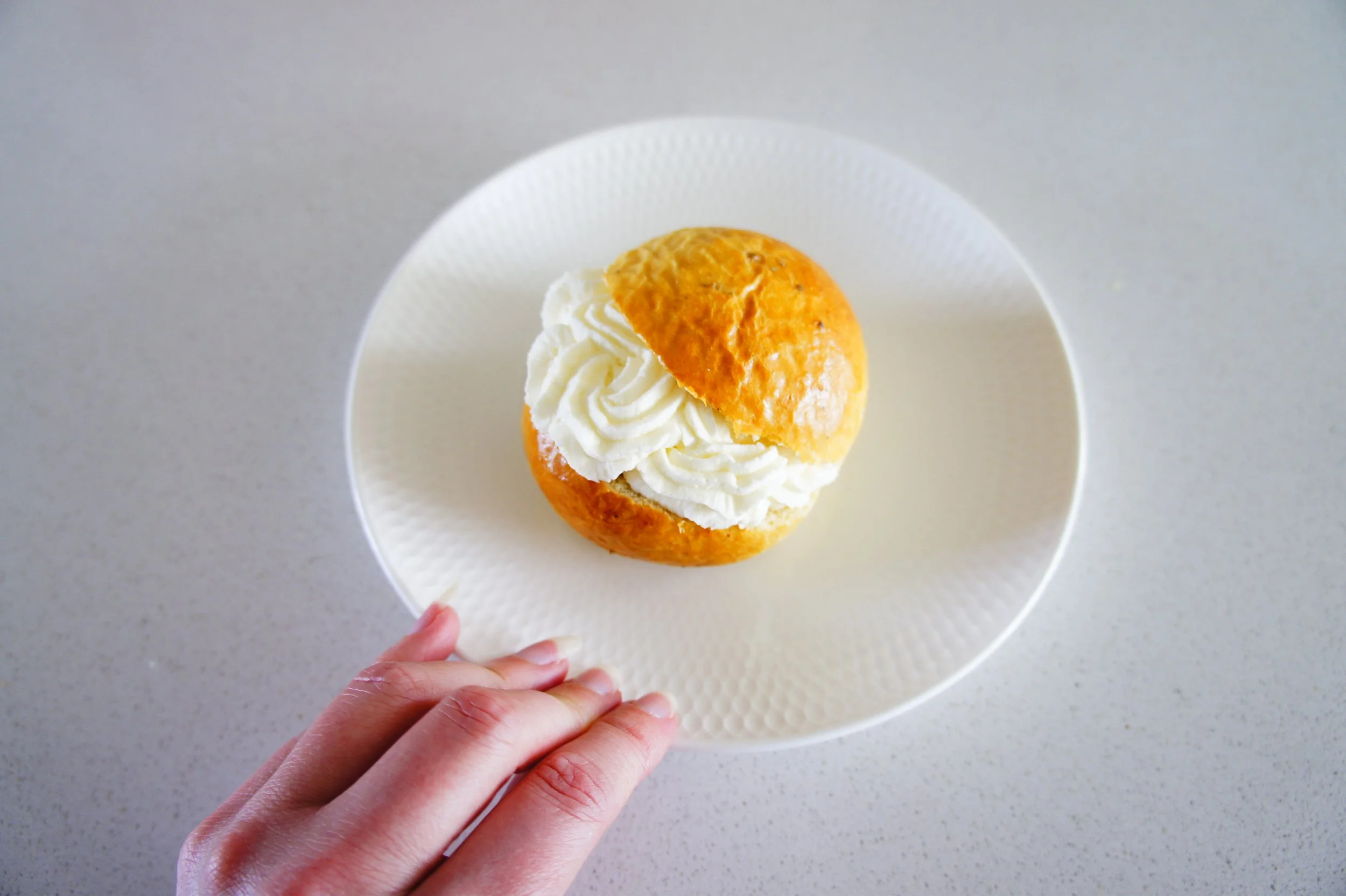
Swedish Semlor buns
Recipe for Lenten-Easter treat, Swedish Semlor buns. Adapted from a recipe by Estonian patisserie owner, Angeelika Kang.
This is perhaps my very favourite enriched doughs to make and to eat.
I first encountered a semla bun in Angeelika Kang’s wonderful baking book, ‘Ovenly Delights’, a book I bought for myself on a winter break in Tallinn, after visiting Angeelika’s delightful Levier patisserie in Kalamaja. Since coming home, her book is a staple in my recipe book library for excellent instruction on how to make the kind of treats you only find in patisseries.
Since discovering this recipe and first making them at home, we have taken two trips to Sweden - Sweden’s West Coast and a Stockholm workation - but never having been there in the Lenten or Easter period (which is when these tend to feature in Swedish bakeries), we have never had the chance to try these in their native land.
Oh well - just going to have to keep making them at home.
My recipe below is derived and modified from Angeelika’s original.
BATCH & BUN SIZE
My estimates are based on a 60-80g size bun per person. This recipe will make about 12 buns, give or take.
TOOLS
Other than the typical kitchen equipment, to make these, you need:
a pestle & mortar for grinding cardamom
a large glass mixing bowl for proving, one that cling film will ‘grip’ onto for a tight drum seal
a flat baking sheet for baking
INGREDIENTS
Dough
250ml full fat milk
24g active dry yeast (not fresh or instant)
100g caster sugar
½ tsp (2g) fine salt
500g strong white bread flour
100g softened unsalted butter
2 egg yolks (30-40g)
30 cardamom pods
Crème Chantilly Filling
600ml whipping cream
4 tbsp icing sugar
For brushing
Egg white + a dash of full fat milk
METHOD
Put the oven on. 50°C (fan or regular).
Remove the cardamom seeds from the pods. Lightly grind in a pestle and mortar. Don’t overdo it – you want to taste and bite into the cardamom seeds in the finished bun.
Warm the milk. Weigh milk into a small saucepan with a temperature probe – heat over medium to 37°C (will take about 4-5 mins). Do not let it exceed 43°C - this will kill the yeast.
Weigh out the remaining ingredients. While the milk is heating, weigh the flour, salt, sugar, yeast, egg yolk, butter and ground cardamom into a large mixing bowl. NOTE! If using dry yeast, weigh this into a separate bowl and hydrate with the warm milk before the next step.
Knead. Once the milk has reached 37°C, pour the warm milk into the stand mixer bowl. Turn the dough out onto the surface and knead for about 5 minutes until the dough is elastic and smooth – a dough scraper can be very helpful at the start of the process when it is quite sticky. You are aiming for a ball of soft pillowy dough that is just lightly tacky.
It may be a little sticky when you start but resist the temptation to add more flour to it. You'll find that with a little work, the dough will begin to lose its stickiness and become smoother and more elastic.
First Proof. Turn the dough out, ball off the dough and place into a large glass mixing bowl. Cover with cling film that is stretched drum-tight across the top. Place in the oven to prove for 45 mins to 1 hour, by which time it should have doubled in size and the cling film will have inflated to a dome. A light press on the dough and it will readily spring back.
******************** WAIT 45 MIN to 1 HOUR **********************
Divide the dough. Once proved, roll the dough into a rough sausage shape and use a sharp knife to cut as equal as you can before weighing each section - you want either 60g (small) or 80g (medium) per ball.
Shape the dough and space out. You are aiming for a domed ball shape with the seam of the dough on the underside. Using one finger, press the sides into the middle. Repeat this several times; you will probably notice the dough getting firmer as you do this. Flip over and using the two edges of your hands, cup under the dough to form a nicely rounded and smooth ball. Plqce onto a lined baking sheet, well-spaced apart, and repeat for the remaining buns.
Second Proof and heat oven. Leave to rise for another 15 minutes. Preheat the oven to 170°C fan, 190°C regular.
Alternatively, if you are prepping in advance, place the buns either in the fridge or the freezer at this point, for baking later. See further notes on storage below.
Egg wash. Wash the tops of each bun – either with a beaten whole egg, or - to avoid waste - some egg white beaten with a dash of cream or milk, whatever you have. Apply wash carefully and precisely, try not to miss any bits for the most professional glossy finish.
Bake. Bake in the middle of the oven:
10-11 minutes for a small bun
12-15 minutes for a medium bun – no more - until the tops are golden brown
Cool completely. Remove from the oven and cool completely before serving (otherwise, the cream will get melty)
******************** WAIT 45 MIN to 1 HOUR **********************
Fill with cream. Whip the cream with the icing sugar, slice off the top of the bun and, for the most professional finish, use a star nozzle to pipe in the cream before replacing the lid and lightly dusting with icing sugar.
STORAGE & FREEZING
Most enriched dough is best eaten on the day it is baked – though you can get away with up to about 48 hours if you keep it in an airtight container but by this time, it won’t be as special and will likely be a bit dry and a bit tough
To freeze before baking (freshest result)
Put into the freezer in an airtight container, just before the second proof.
When you want to bake them, take them out of the freezer and immediately place onto the lined baking sheet that you plan to bake them on. Leave in a warm place to thaw and rise - the time for this will vary depending on the temperature of the room though I typically find about 2-3 hours for these. You will need to check the dough regularly; it needs to be baked as soon as it has completed its defrosting (it should feel slightly puffy and your finger should leave an indentation if the dough is pressed lightly.) Now continue the recipe from the baking step.
To freeze after baking (most convenient)
Freeze on the day of baking immediately after they have cooled.
To serve, warm in the oven for 15 minutes at 160°C fan (no need to preheat – put straight in on a tray). After this time they should be fully defrosted, warm and slightly softened – almost as good as freshly baked.
Småland, Sweden: a leisure cycling travel itinerary
Travelling in summer, my imagined itinerary for 7 nights in Smaland, Sweden. Cycling amid lakes, islands, country lanes, and deep forests.
Why Småland?
Research for this trip started with a friend, who ran an ultra-marathon around the island archipelago of Stockholm, extolling the virtues and beauties of this region. So I set a-looking for a possible trip to Sweden.
Turns out, the archipelago around Stockholm is famed for its beautiful maze of waterways and islands, peppered with second homes and cabins owned by city residents in pretty coastal towns for weekend trips and outdoor activities. While stunning, the many islands often means travel by boat and my other half gets badly seasick so I started to rule it out……………but Sweden looked too much like the exact kind of place I like to holiday, so I continued doggedly researching.
Gothenburg, Värmland, Lake Vänern, Öland………on and on I went, looking at places to stay and things to do, trying to spot the one that just seemed to tick all our boxes……….until a chance stumble had me in Småland and that set my tail wagging.
It is a land of deep forests, sparkling lakes and teensy cities punching above their weight with foodie and cultural scenes to rival that of larger urban centres. There are proper MTB facilities at various trail centres around the region. Other fun facts include that IKEA grew from being a small mail order company in the forests of Småland to the global phenomenon it is now, and between Växjö and Kalmar on the coast is the famed ‘Kingdom of Crystal’ - a string of glass-blowing communities reinvigorated, revitalised and turned into a unique tourist destination. Many describe this place as all of Sweden in miniature.
Itinerary At A Glance
7 night independent itinerary for Småland in southern Sweden
Based on flying in and out of Gothenburg from Leeds with a hop in Amsterdam. Car will also be essential to move between locations
Highlights include biking the countryside, outdoor forest dining, experiencing the traditions of the glassblowing villages and some art locations celebrating the Swede’s famed sensitivity to great design
Based on a couple travelling, with a focus on leisurely cultural activities and biking, interspersed with time to just relax and soak up the atmosphere
WHEN
June or July
For the driest, warmest and lightest months, but I would still plan for mixed weather.
TRAVEL MEANS
KLM, from Leeds into Gothenburg, changing in Amsterdam
This trip will also require car hire for the entirety of the trip, along with bike hire which is capable of handling gravel surfaces
ACCOMMODATION
To make the most of the weather, the views and the outdoorsy nature of this trip, a traditional Swedish summer house - ferienhaus - would be my top pick ideally with some outdoor space. Either Gränna, Jönköping, or the stretch of land between them would make a good base. In order of preference:
Gorgeous and modern ferienhaus on the edge of a small lake between Jönköping and Växjö
Apartment in a listed building in Gränna, overlooking Lake Vättern
Modern countryside ferienhaus between Jönköping and Växjö
Apartment on the Smålandsgården estate in Gränna
IMPORTANT NOTE FOR BOOKING! Summer accommodation in the Swedish countryside books up very very quickly - note that its is also very common for self-catering homes to only allow a minimum of a 1 week stay, and not uncommon for them to enforce a 2 week minimum stay. This is a holiday where you will need to plan well in advance and get booking.
SCHEDULE
Day 1 - arrive
Try to arrive in the morning
Day 2 - biking Visingsö Island on Lake Vättern and explore Gränna
In the morning. head to Visingsö Island to bike the 25 km island perimeter path which takes between 2 and 3 hours. Lush oak forests and farmland co-exist on Visingsö, and along the way are several possibilities for a picnic break. More info found here
Explore the town of Gränna in the afternoon and stay for dinner
Day 3 - Experience the Crystal Kingdom (Glasriket in Swedish)
The Glass Kingdom is a cluster of villages between the cities of Kalmar and Växjö, which has been the centre of the country’s world-renowned glassblowing community since 1742. There is the Kosta Boda Art Gallery, designed by Bruno Mathsson in the early 1950s. At the Glassworks in Målerås, you can have a go at glassmaking, wander the walking/biking path and, most excitingly, partake in a traditional ‘hot shop herring’ evening meal (hyttsill in Swedish). Hyttsill evenings date back to the days when the glassworks acted as a focal point for the local community – an after-hours meeting place for workers, hunters from the surrounding forest and, not least, wandering tramps. When the glassblowers go home for the day, long tables are set up in the glassworks and the chef fries salted herring in the cooling pipe – where earlier in the day, finished glassware has been slowly cooled down. He brings trays of crispy bacon and isterband sausages to the table. Jacket potatoes, genuine Småland ostkaka pudding. Glasses are filled with chilled beer from the basement… Soon, the singing creates a warm atmosphere in the smeltery
Day 4 - biking Åsnen National Park and dinner in Växjö
About 40 minutes south of Växjö, is the Åsnen National Park, the newest in Sweden. Spend the day cycling its lanes, forests and lakesides, using this helpful site for inspiration on routes
Have dinner in Växjö, whose culinary scene rivals that of any larger city. Five of its restaurants are featured in the White Guide (Scandinavia’s leading restaurant guide), and the hotel/restaurant PM & Vänner was awarded a Michelin star for its modern take on Småland cuisine.
Day 5 - long day ride loop from Jönköping to Bunn and back
90km round trip on quiet country roads, this loop apparently takes you through some of loveliest countryside, into the famed village of Bunn, and back into Jönköping. Budget for 6-7 hours on the bike with more info here.
Day 6 - foraging and forest dining
Make a booking at one Smaland’s Edible Country Tables using this guide for what to forage from the Sweden countryside
Day 7 - long day ride loop between along the southern edge of Lake Vättern
70km round trip through the apple orchards and country lanes between Jönköping and Gränna
Day 8 - final breakfast and head home
Have one final breakfast of coffee and kanelbulle (cinnamon bun)
Try to leave in the afternoon
Back-up plans for rainy days
Longest zipline in Europe at Little Rock Lake
Visit the IKEA Museum in Älmhult, on the central southern border of the region
Take an Elf Safari at Grönåsen Elk and Livestock Park
Visit Vandalorum Art & Design Museum in Varnamo (between Jönköping & Växjö)
FOOD AND DRINK - SPECIALITIES & CUSTOMS
Isterband (pork, barley and potato sausage) with pickled beetroot and dill-stewed potatoes is a classic Småland dish.
Other Summer Stuff
The Swedish West Coast - a twin-centre itinerary with biking, hiking, sculpture and excellent baking
Travelling in early summer, how we enjoyed 12 nights on the West Coast of Sweden. Hiking, biking and outdoor dining all feature.
Why the Swedish West Coast?
The entirety of Sweden’s coastline is both vast and varied - there are rocky granite coasts, deep sand-dune backed beaches of fine golden sand, vast island archipelagos of islands, islets and skerries connected to the mainland by bridges or chain ferries, forests right up to the coast, high cliffs, even inland lakes the size of inland seas. Just off the coast there are deep forests and meandering lanes amid a patchwork of meadows and farms.
The West Coast of Sweden has Gothenburg (Sweden’s second largest city, and home of Volvo) as the major urban base, but outside of that there is plenty of nature, both wild and tamed, for outdoor exploring, either on two wheels or on two feet. This is the summer playground of many a-Swede but not often visited by folks from the UK, so naturally, I feel like a jammy bugger, excited to be discovering something so authentically Swedish.
We based ourselves in Halland, just south of Gothenburg. It’s beachy, breezy, and brilliant for bikes. Halmstad, the main town, kicks off Sweden’s first national cycle trail and has a laid-back, surfy vibe.
Head north and you hit Bohuslän, a dreamy stretch of smooth granite islands and tiny fishing villages. It’s all red cottages, salty air, and kayaks weaving through the islets. It feels like a postcard.
We spent 12 sun-soaked days here—27°C and blue skies the whole way. Apparently, that’s rare. But we’ll take it.
Itinerary At A Glance
12 night independent itinerary for Halmstad in Halland province and Orust island on Bohuslän coast
Based on flying from Leeds into Gothenburg, with a hop in Amsterdam
Highlights include DIY outdoor dining in one of the Edible Country tables, Bronze Age rock carvings, biking the famous Kattegattelden coastal trail, hiking and outdoor cooking in the forest on Midsummer’s Eve, and plenty of fresh baked goods at cafes with seaviews
Based on a couple travelling, with a focus on leisurely cultural activities and biking, interspersed with time to just relax and soak up the atmosphere
WHEN
Late June/early July
Driest, warmest and lightest months, plan for mixed weather.
Note also that, outside the major urban centres, many of the summer homes, tourist attractions, ferry routes and eateries are only operational May to September, so visiting outside of these times is a very different (and probably trickier) prospect.
TRAVEL MEANS
Leeds to Gothenburg with a hop in Amsterdam, flying with KLM
Car also be essential to move between locations, as well as road or hybrid bike hire for the entirety of the stay in Halmstad
ACCOMMODATION
Halmstad/Halland province
We stayed in this Cosy and luxurious villa on the outskirts of Halmstad.
Quiet. Large outdoor space including pool and cooking area. Proper family home with all the mod-cons. Recommended.
Bohuslän Coast
We stayed in this Gorgeous and modern coastal home with incredible views out to sea from the deck.
Recommended, especially if you particularly prize a peaceful and out-of-the-way location.
SCHEDULE
Halmstad in Halland province - Day 1 to 7
Day 1
Arrive: drove to Halmstad from Gothenburg
Collect Bike Rental from Rent-A-Bike Halmstad
Day 2
Bike: Pick a section of the Kattegattelden cycle trail using this extremely handy and comprehensive website to the trail, with an option to download the GPX files.
Cafe: Stopped at neighbourhood cafe Borjes Harplige Konditori for a pitstop and has my very first try of a chokoladbollar. Flipping marvellous and a wide selection for such a small village bakery.
Dinner: at the house
Day 3
Lund: This was one of our only rainy days, on which we headed out to Lund, the ‘Oxford of Sweden’, 1h 30m drive to the south.
Wandered the town, and stopped for coffee and baked goods before heading home - specifically Ramklints Konditorei for traditional Swedish patisserie and Lund Gateau Saluhallen
Day 4
Hike: Went on this Gourmet Hike tour with Anders. Cooked outdoors and checked constantly for ticks…..found some as a matter of fact…
Day 5
Bike: Pick a section of the Kattegattelden cycle trail which includes Falkenberg and explore the town as part of the route
Dinner: Booked in at Köketin Falkenberg, recommended by the White Guide - an excellent choice. The food and the service was superb, proudly Scandi, and just on the right side of ‘fine dining’. Not so progressive that it felt ‘try hard’ but still special enough to have felt like a proper treat. This wasn’t food I can make at home.
Day 6
Relax: enjoyed the hot weather in the garden
Dinner: BBQ outside
Day 7
Fika: Anders (our tour guide) and his wife, Viktoria, invited us for fika at their home in Halmstad. Viktoria baked a variety of teeny little bakes, from chokoladbiskvier to slices of Prinsesstårta. We sat outside in the shade of a tree with coffee and delicious baked goods and told each other some stories.
Deeply grateful for their invite to join us at their home. A highlight of our trip, for sure.
-
Spend an evening at Rotundan in Norre Katts Park in central Halmstad, with street food options with a musical performance from their cultural program
Take a guided tour of Tjolöholms Slott (Tjoloholm’s Castle)
Visit the Bath House at Varberg (Kalbadhuset Varberg) for a sauna and fika
Take a wander around Helsingborg
Take a trip out to Varberg to dine at Spiseriet (for tables of less than 6 people, it is drop-ins only)
Spend an afternoon in Halmstad, using this self-guided history walk as my rough guide - its only in Swedish but nice to have a paper copy for a bit of slow-ways pathfinding
Stop in for lunch or fika at Söderfamiljen in central Halmstad for a view over the river
Visit the Halland Art Museum or Mjellby Art Museum, to get to know a little more about artists in the region
Book in to ÄNG restaurant on the Ästad Vingård in Halland County. Recently awarded both 1 Michelin Star and a Michelin Green Star - first introduced in 2020, the Michelin Green Star is an annual award which highlights restaurants at the forefront of the industry when it comes to their sustainable practices
Do a local beer tasting on Friday or Saturday nights at Halmstad Brygghus
Day 8 - drive between Halmstad & Bohuslän
Made a pitstop at the café town of Alingsås, the Swedish Capital of Fika, for a wander around the town and its many cafes. Cute, not astounding.
About 300km, 3hrs 30mins driving
Bohuslän Coast - Day 8 to 13
Day 8
Settle in, buy supplies
Day 9
Sculpture Park: Went to the Pilane outdoor sculpture park on Tjorn, open May to September from 9am to 7pm. Gorgeous.
Lunch: Dined in the courtyard under the blazing sun, at Margareta's Koko Skafferi, Sunsby Sateri. Set in a historic manor estate, the café blends old-world charm with cozy vibes. You can sit indoors among vintage furnishings or outside surrounded by gardens.
Walk: there are walking trails at Sundsby Sateri. We took to one after lunch, to work off the kladdkaka…….which was utterly excellent - a crisp shell with a gooey interior - but also extremely indulgent.
Dinner: at the house
Day 10
Museum: Visited Nordic Watercolour Museum on Tjorn Island
Lunch: Lottas Bak & Farm (Lotta’s Sourdough Bakery & Cafe). Open Wed-Fri 9am to 5pm, Sat 8am to 3pm, Sun 10am to 3pm. A delighful neighbourhood cafe with a back terrace that looks out over a teensy little inlet. Tranquil and relaxed, with great food and an on-site bakery. An ideal spot for a sit-down.
Day 11
Visited the Vitklycke Museum and rock carvings in Tanum, member part of the World Heritage list as an outstanding example of Bronze Age art. Visitors can either join a guided tour or follow the well-marked six kilometre path for an exploration of the many rock carvings at this site. Open 10am to 5pm June to August (more limited opening times April, May, Sept, Oct and Nov).
We chose the independent option.
Pretty breathtaking. The carvings are highly visible, having been repainted to really stand out, and its rather mindbending the quantity that there on the site.One in particualr is a huge depiction of a man, way bigger than human size.
Highly highly recommended.
Day 12
Forgaging & outdoor dining: Booked on one of the Edible Country tables at Ramsvik. Stunning stunning location, perched on a cliff looking out over The Skagerrak—a strait that connects the North Sea to the Kattegat and separates Sweden from Norway and Denmark.
The foraging though, was very very difficult, having only been provided with a stylised line drawing
Day 13
Have one final breakfast of coffee and kanelbulle (cinnamon bun)
Try to leave in the afternoon
-
Wander around Marstrand on Kungälv island
Make day trips to visit a couple of the prize spots on the island of Orust - Gullholmen and Mollösund
Hike Dyron Island boardwalk trail, ending with a stop at the public sauna
Dinner at Brygghuset, Fiskebäckskil- multiple winner of the Whiskey Restaurant of the Year Award, and reputedly knowledgeable in all things seafood

