A Journal

A personal journal that invites readers to design their own journeys through the world - with travel, dress and taste.

Search Posts:

Jump to

Travel

Jump to

Wardrobe

Jump to

Eat

Eat, England, Spring, Winter Frances Lawrence Eat, England, Spring, Winter Frances Lawrence

Rhubarb & Rose Compôte

Recipe for a fragrant rhubarb and rosewater compote. An utterly delightful flavour combo and a taste of The British Isles.

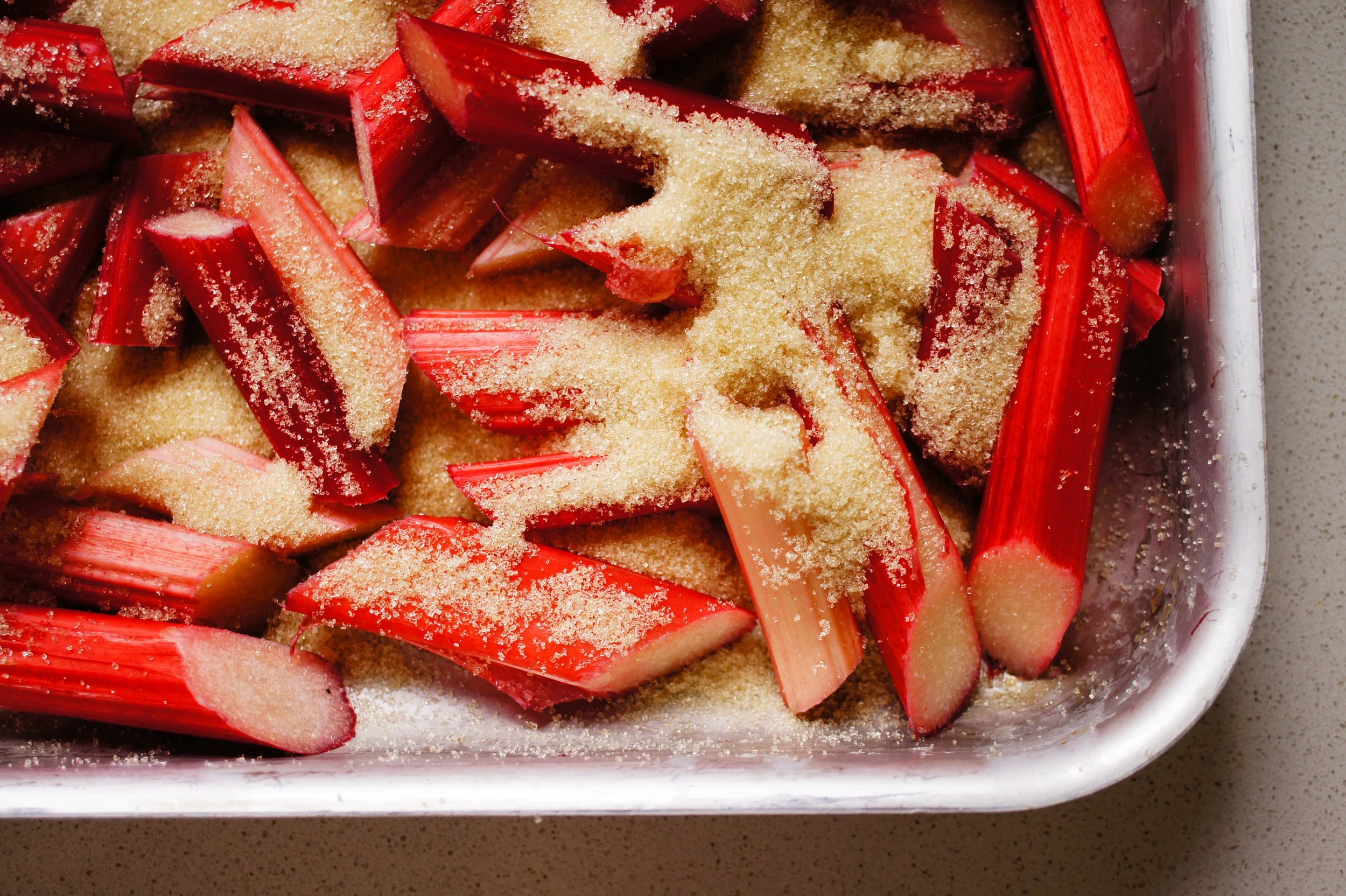
pink rhubarb chopping in a shallow baking tin with caster sugar

There are two rhubarb seasons - one is late winter, early spring, when the crops of pink, forced rhubarb are available, and one is the summer, when the abundant crops of green rhubarb are endlessly sprouting stalks in veg patches and borders up and down the land.

This recipe is designed for the former, the pink kind, particularly if you intend to serve the compote appetisingly atop a crepe, yoghurt or cake. While the green summer kind will taste exactly the same, it will not have the aesthetic appeal of the pink winter version, especially if you want to turn the puree into some other topping like on a cheesecake.

If you only want it for the flavour and don’t need any of the colour, this recipe will produce the same result either which way.

My recipe below is my own.


PORTION SIZE

Makes about 700ml – roughly the amount of 2 large mugs.

TOOLS

Other than the typical kitchen equipment, you will need:

  • a roasting tin with sides, about 4-5cm deep

INGREDIENTS

600g rhubarb (about 10 stalks) **forced, pink ones will make a pink compote; the green summer rhubarb will be a sludgy green colour

100g golden caster sugar

1 to 1 ½ tsp rose water

1-2 drops pink food colouring (optional)

Ratios

  • 100% fruit, 15% sugar

  • Approx. ½ tsp rose extract per 300g fruit

Variations

  • with orange or lime zest – omit the rose water and zest the citrus fruit onto the compôte just after it comes out the oven. Stir to combine.

  • with strawberries — swap half the rhubarb for strawberries

  • With vanilla – stir 2 tsp vanilla paste onto the compôte just after it comes out the oven. Stir to combine.

  • With rosé wine or liqueurs – add 2 tbsp rose wine, elderflower liqueur, Grand Marnier, Chambord etc. to the roasting tin with the raw rhubarb and sugar. Roast together.

  • With cardamom – grind the seeds of 4 cardamom pods and add to the roasting tin with the raw rhubarb and sugar. Roast together. Omit the rose water.


METHOD

Heat oven. Preheat the oven to 180°C fan

Prep rhubarb and any extras. Cut the rhubarb into large chunks and place in a roasting tin with the sugar. If any of your extras need to go in before roasting, add here.

Roast. Cover with foil and cook for 15‐20 minutes or until the rhubarb is tender and the sugar has dissolved into a lovely pink syrup. Expect it to be pretty wet.

Finish. Stir in the rosewater (or any other optional extras, and a drop or two of pink food colouring if you want to amp up the colour), then spoon into a bowl and set aside to cool completely.


USES

  • Dollop onto rice pudding, porridge or crepes

  • Blend into a smoothie

  • Use as a fruit puree for cheesecake topping

  • Serve alongside a cake (particularly a dense type of cake such as a Madeira cake or olive oil cake)

Read More
Travel, Winter, Europe, France Frances Lawrence Travel, Winter, Europe, France Frances Lawrence

Brest in Winter - combined biking with city break

Brest in Finisterre in the off-season. Winter hikes, thalasso therapy, eating crepes, and admiring the early sunset off the west coast.

Itinerary At A Glance

  • 4 night independent itinerary for the very northwest tip of France - Finistère in Brittany - choosing the outskirts of Brest as the base

  • Based on travelling at the very end of winter/start of spring, flying in and out of Brest. Car will also be essential to move around.

  • Highlights include a winter hike around the Crozon peninsula, artisanale beer and lemonade, biscuits and a visit to one of the most important oceanogrphic centres in the world.

  • Based on a couple travelling, with a focus on leisurely cultural activities and biking, interspersed with time to just relax and soak up the atmosphere


Why here? Why March?

Brittany is almost always shown in summer — search the internet and its mostly golden light and blue skies. But March offers a different perspective. The climate is similar to southern England: mild, wet, and unpredictable. Expect anything from crisp sunshine to bouncing rain, even the odd snow flurry. It’s not warm, but it’s rarely bitter — daytime temperatures hover around 8–11°C.

This trip uses the outskirts of Brest as a base, giving easy access to coast, countryside, and culture all within an hour’s drive. Finistère, the westernmost part of Brittany, is wrapped almost entirely by ocean. Like Cornwall, with which it shares Celtic roots, the region has an island-like feel: the sea is never far, and often in view.

Brest itself is a major urban centre, rebuilt after heavy WWII bombing. While it lacks historic architecture, it makes up for it with a lively harbour, a strong maritime identity, and a surprising claim - it’s considered the European capital of oceanography, home to over half of France’s maritime researchers.

In March, staying near a city makes sense. Weather may force changes, but museums, galleries, and restaurants stay open year-round. It’s a practical base for an off-season road trip, with plenty of indoor options when the outdoors won’t cooperate.


WHEN

March

Likely chilly (but not freezing)

Like the UK, March can be either cold and snowing, or warm and sunny, with spring bursting forth early. Take clothing options and plan activities that account for these unknowable circumstances.


LIGHT

Moderate daylight

Sunrise: 07:59am to 07:58am

Sunset: 19:02pm to 20:47pm

11-12 hours of daylight


TRAVEL MEANS

EITHER

Fly indirect from Manchester to Brest with AirFrance, transferring through Paris

OR

Fly indirect from Leeds to Brest, with KLM-AirFrance, transferring through Amsterdam and Paris

OR

Fly Liverpool to Nantes with Easyjet, then drive 3h 45m to Brest

In summer, there are many more flights, including Leeds to Brest via Dublin, with AerLingus.


ACCOMODATION LOCATION

Near Brest

Just outside of Brest is the Plougastel-Daoulas peninsula, which is easily accessible to Brest via a bridge over the water that connects the two.

There is also the commune of Le Relecq-Kerhuon, just to the east of Brest and giving right out onto the beach.

Either of which would make an excellent base for the delights of both city and country. The views in this part of Finistère are all about ocean, ocean, ocean.


SCHEDULE

Day 1

Fly in the morning, drive in the afternoon, collect groceries, arrive and settle in

Day 2

Brunch: at La Coloc overlooking Brest harbour

Visit Atelier des Capucins: Former shipbuilding workshops, now the largest covered public square in Europe. A huge and diverse public meeting spot with food, performance, art, shopping…also accessible by cable car!

Visit ocean museum 70.8 maritime innovation gallery: Opened in 2020, and located in the Atelier des Capucins, 70.8 is a center for technical and scientific culture dedicated to the ocean, presenting maritime innovation in all its aspects.

Tour Tanguy: for an immersive experience of Brest’s long history

Day 3

Hike Crozon peninsula: Drive to Crozon for a hike

Day 4

Relax

Le Comoedia Galerie d'Art: contemporary gallery with a strong focus on street art

Brasserie Poem Brewery, making artisanale beer and lemonade (Bar open from 4pm to 12:30am on weekends, with tours of the brewery available Fridays only, 9am to 5pm)

Evening Show at Le Quartz theatre

Day 5

Travel home


Ideas for another visit

  • Visit Peck & Co, a gastronomy concept store, a dining boutique with various inspirations, a place where you can snack from 9:00 a.m. to 7:30 p.m

  • Lunch at Le Castelach

  • In summer, visit the Crozon peninsula by sea, on board the Brestoâ or the Loch Monna from Brest

  • In the summer, every 4 years (next is 2028) is the International Maritime Festival, where a flotilla of traditional boats gather in the harbour from all over the world, alongside a programme of artistic and cultural performances


Other Off-season Itineraries

Read More
Sweden, Eat, Winter Frances Lawrence Sweden, Eat, Winter Frances Lawrence

Swedish Kokosrulad (coconut roll cake)

Recipe for Swedish Kokosrulad, a coconut roll cake filled with a custard buttercream.

Not too sweet, soft texture, moist middle and very delicately flavoured.

Aside from the taste (one of my absolute favourites), I love that this cake keeps well in the fridge and I find it delightful served chilled. Due to this, it’s a great option to make ahead of time and conveniently store ready for later devouring, and is an absolute delight on a hot summer’s day.

The sponge relies on getting the eggs and sugar whisked up to ribbon stage, which takes a good 10 minutes on high speed - a stand mixer helps a lot here as you can get on with other tasks while it is labouring away. Otherwise, a handheld electric whisk will do the job equally well, but whatever you do, don’t get impatient and attempt to shorten this task. It really makes a difference to the lightness of the final sponge.

My recipe below is derived and modified from an original in the excellent guide to Swedish baking, Fika - The Swedish Way, published by Norstedts.


PORTION SIZE

Makes 12-14 moderate slices

TOOLS

  • a blender or food processor

  • a stand mixer or handheld electric whisk

  • a 30cmx40cm shallow roasting tin with sides, 3-4cm deep

INGREDIENTS

Cake

120g desiccated coconut

60g (3 tbsp) potato starch or potato flour

1 ½ tsp baking powder

3 large eggs (about 160g out of shells)

180g caster sugar

Caster sugar, for sprinkling

Custard buttercream

75g unsalted softened butter

100g caster sugar

150g ready-made custard or homemade crème pâtissière, at room temperature


OPTIONAL For the crème pâtissière

25g plain flour

25g cornflour

300ml whole milk

1 ½ tsp vanilla paste or seeds from 1 vanilla pod

2 large eggs

50g caster sugar


METHOD

OPTIONAL – For crème pâtissière

Make a paste - Weigh the two flours into a small bowl and weigh in about 50ml of the cold milk, working it all into a paste with the back of a spoon or a small whisk. Make sure there are no lumps; set aside.

Warm the milk - Weigh the rest of the milk and the vanilla into a small saucepan and place over a low-medium heat until scalded.

Mix eggs and sugar to ribbon stage - Weigh the eggs and sugar into a medium bowl (having the ingredients form some depth in a smaller bowl helps with the whisking) and use an electric whisk on high to mix until pale and fluffy – expect about 4-5 minutes to reach the volume. You are aiming for the ribbon stage, which it is very pale and fluffy, about 5 times the original volume, and the mixture leaves a trail (a ribbon) when the whisk is lifted.

Heat to thicken - Add the flour-milk paste and whisk to combine. Pour over the hot milk and whisk again. Pour everything back into the pan and cook over a low-medium heat until thickened.

I alternate between letting it sit on the heat to thicken, and stirring, switching between a balloon whisk and a spatula to work out the foamy bubbles on the top and the thicker sections as they form on the bottom. I find this whole process can take 10-15 minutes – don’t be tempted to crank the heat up.

You can choose how much to thicken it, but it is ready once it easily coats the back of a spoon and leaves an open trail if you run a finger across it. You can take it thicker if you wish, until it is decidedly thick like the consistency of extra thick double cream, which I think is better for this recipe.

Chill - Pour into a glass bowl and cover with the clingfilm touching the top. Chill fully.

For the roulade

Prep oven and baking sheet - Preheat the oven to 200°C fan, 220°C regular. Line the bottom of the roasting tin with reusable or greaseproof paper.

Mix eggs and sugar to ribbon stage - Weigh the eggs and sugar into a large bowl or the stand mixer. Whisk for at least 10 minutes on high speed – it really does take this long to get the right volume. You are aiming for the ribbon stage, which it is very pale and fluffy and about 5 times the original volume.

If you are using a stand mixer, you are free to continue with other tasks.

Combine & fold in dry ingredients - Weigh the desiccated coconut, potato starch and baking powder into a bowl and use a balloon whisk to combine these dry ingredients together evenly. Fold the dry ingredients into the egg-sugar mixture in a few goes. The mixture should be very light and fluffy, almost like a meringue.

Pour batter into baking tin - Pour the cake mixture into the tin, level the top and use a cranked spatula to encourage it into a rectangle but do not push it all the way to the edge of the paper – it will continue to spread a little during baking and you don’t want it too thin as it is delicate once baked and can easily tear. Tap once to release air bubbles.

Bake - Bake in the middle of the oven for 5-7 minutes. It is done when golden on the top, probably with some huge bubbles, and springy to touch. Bring out the oven and complete all the next steps immediately, with the cake still warm.

Sprinkle with sugar and remove from tin - First, use a spatula to loosen the edges and make sure you can lift the reusable paper all the way round the edge. Next sprinkle the top with caster sugar, then lay a sheet of greaseproof paper and then a sturdy clean tea towel over the top of the tin. For extra precaution, put two elastic bands around all this at each short end. In one quick and decisive motion, flip over so that the sugared sponge top drops onto the greaseproof. Hold the edges tightly – you don’t want this to slide out of the side.

Roll up and cool - Carefully peel off the reusable paper that was on the bottom, then roll up loosely with the greaseproof paper inside. Leave to cool on a wire rack.

*************** WAIT 1 HOUR **************

Finish the custard buttercream - Beat the sugar and caster sugar together until fluffy, then add the custard/crème pat in two or three sessions and beat to combine.

Fill and roll up - Once everything is cooled, gently unfurl the rolled cake and spread the buttercream right to the edges, then roll up fairly tightly, aiming for no gaps.

Chill - chill for at least 30 minutes before serving

*************** WAIT 30 MINUTES **************

SERVE!

Cut into slices 2-3cm wide.


STORAGE

Store in an air-tight container in the fridge; stored well for about 3-4 days.

I also really like this chilled, and served cold from the fridge.

An excellent candidate for freezing and fika, simply slice up and store in airtight bags in the freezer for up to 3 months. A slice only needs about 15 minutes to defrost.

Read More
Wardrobe, Winter, Dressmaking Frances Lawrence Wardrobe, Winter, Dressmaking Frances Lawrence

Ultra wide leg flat-front trousers from Burda 6966

The simplicity, elegance and sophistication of sewing trousers in single wool crepe.
TOTAL TIME COMMITMENT: 9 hours

Toile (without zip, buttons, lining, interior seam finishing, basting stitch removal or hemming): 4 hours

Cut out & transfer all pattern markings (both main fabric and interlining): 1.5 hours

Main construction: 5.5 hours

Lining construction: none

Finishings (hooks, hem): 1.5 hours


Fabric type

Single wool crepe

Fabric weight

280-300gsm


PATTERN CHANGES

Added a little extra flare from the hip down to the hem

Adjusted the fit by lengthening the crotch

SEAM FINISHING & DECORATIVE EXTRAS

Outside leg seams – overlock together

Inside leg seams – overlock together

Crotch – overlock each side separately

Do a lapped zip, rather than a centred zip


VERDICT & LESSONS LEARNT

Very quick and easy to make.

This is a gorgeous, ultra-simple wide leg, which makes a fabulous pair of trousers, with a very minimal upper section (narrow waistband, no pockets, and zip in the centre back) which is flipping excellent for pretty much anything, but particularly a long line top which I want to style left out – its very smooth underneath the top.        

The ultra wide leg of Version A brings the drama when paired with a plain fabric.

The work I did to correct the fit of this pattern, means this is now perfect on me.

Using single wool crepe for this was a BRILLIANT idea. It is fluid, and classy. I also don’t find it needs lining.


Other Ideas for Winter

Read More
Travel, Winter, Europe, UK, Wales Frances Lawrence Travel, Winter, Europe, UK, Wales Frances Lawrence

Pembrokeshire in Winter with mountain biking and boutique hotel

Itinerary journal of my winter break in Pembrokeshire. Biking, boutique hotel and Michelin food.

Itinerary At A Glance

  • 4 day independent itinerary for Pembrokeshire in South Wales, based on driving from Leeds, in February

  • Highlights include mountain biking, a trip to St Davids, winter hike with mysterious standing stones, and staying at Grove of Narberth with 4 AA rosette fine-dining

  • Based on a couple travelling, with a focus on leisurely outdoor and cultural activities, interspersed with time to just relax and soak up the atmosphere


Why here?

We’d never been to Pembrokeshire, and winter felt like the right time to explore somewhere new without the crowds. Most of the UK stays open year-round, even if a few attractions close — so we decided to chance our arm and see what this corner of Wales had to offer off-season.

It was an anniversary trip, so we treated ourselves to a luxury boutique hotel stay — made sweeter by off-peak prices.

The only thing we couldn’t plan, was the weather. All we dared hope for was dry………..we got our wish.

Honest verdict

Did I enjoy the holiday?

We definitely enjoyed this trip - a great off-season alternative for visiting South Wales which is much more typically a summertime destination. The UK actually experiences a very mild winter, with temperatures below zero a fairly uncommon ocurrence, so if you can dress accordingly, many of the outdoor exploring options like hiking and biking remain viable activities even in our coldest months. This is what I was banking on for this trip, and it came good.

Does the place live up to expectations?

Yes and no. The hotel was absolutely outstanding - cannot recommend enough. The Pembrokshire region though, was not my favourite place we have visited in the UK , and I do think we have more beautiful and more picturesque countryside, with a greater variety of things to do. In Wales itself, the North has much more dramatic landscapes and other spots offer better mountain biking. None of this is to say it isn’t worth a visit, but I would say for me, other places hold more appeal.

Did the itinerary work for the trip?

Absolutely - it was the perfect blend of active and restful, mucky and refined, and a great option for the off-season. We were lucky with the weather, as we could have gotten very cold and snowy conditions, but also had back-up options in case that happened.

Would I make another visit?

As much as this was a great trip, particularly considering the fact that it was mid-winter, I can’t personally see myself returning to this part of Wales again; other parts of Wales have more dramatic scenery and more history that I would rather visit instead.


WHEN

February

This is very much off-season for February, so quiet, and many of the typical tourist attracttions may be closed over the winter. An ideal time to enjoy the more local-focused activities and hangouts.

We got cold, dry and cloudy. May be freezing with snow.


LIGHT

Short-ish days

Sunrise: 07:39am

Sunset: 17:28pm

10 hours of daylight


ACCOMMODATION

We stayed at Grove of Narberth

This place was marvellous - very possibly the best hotel we have ever stayed in. Boutique, welcoming, incredibly welcoming and stylish decor, and outstanding service with a superlative restaurant on site. Highly highly recommended.


TRAVEL MEANS

Car & Bike

Driving from Yorkshire to Pembrokeshire, with an overnight rest-stop in Snowdonia on the way down. About 6 hours each way.

Mountain Bike for activities whilst there.


SCHEDULE

DAY 1 - Wednesday

Drove Leeds to Coed y Brenin Trail Centre for a half-day mountain biking

Overnight in George III Pub with Rooms

DAY 2 - Thursday

Drove along the Coastal Way from Snowdonia to Narberth

Rest stop in Cardigan at Crwst: very enjoyable visit to this fantastic spot for breakfast, brunch or coffee. Open, industrial, proper bakery - top notch

Walk: Pentre Ifan walking circular - 6.85km

Check-in & Dinner at Grove of Narberth

DAY 3 - Friday

Bike ride: Local route out from Grove of Narberth

Visit St Davids: holder of the title “smallest city in the United Kingdom by population and urban area.” This place is truly teensy, more like a village

Fish & Chip dinner: The Shed, Porthgain. You would never happen upon this place - beautifully positioned at the mouth of a tiny inlet that would once have been a fishing community. Informal, local, buzzing. Recommended

DAY 4 - Saturday

Bike ride: red route at Llys-y-frân reservoir

Dinner: Fernery Restaurant at Grove of Narberth, holder of 4 AA Rosettes. Absolutely outstanding from start to finish.

DAY 5 - Sunday

Drove home


Back-up plans for rainy days

Plans for another trip


Other Countryside Itineraries

Read More
Travel, Winter, Europe, Poland Frances Lawrence Travel, Winter, Europe, Poland Frances Lawrence

Krakow - learning Polish in Winter

My itinerary journal for 9 frigid nights spent in Krakow learning Polish, in January. Heavy snow and hard pronunciation…..also excellent pierogi and a delightful surrealist art find.


Why Krakow?

Krakow is perhaps the jewel in Poland’s touristic crown. It is a former capital of Poland, famed in particular for it’s architecture that miraculously escaped destruction in World War II, with that classic ‘chocolate box’ cuteness of Central European cities.

I have it in my head that Poland is the up-and-coming cool place to be. I am convinced this country has everything to offer the savvy traveller who likes to be off-the-beaten track but not out-in-the-wilderness. I think its got all the same draws as more well-known destinations like France, Croatia or Italy - great accommodation options, interesting cities which combine culture, history and modernity, pronounced seasons, and varied landscapes including coast, forests, lake districts, rolling greenery and mountains. The only lack seems to be beaches for sunbathing (I know many would argue there is the northern Baltic coast, but Baltic beaches aren’t known for their sunbathing potential). It is very easy to get to from the UK, with many flight options to Poland’s cities. To top it off nicely, the prices are much cheaper than should be expected elsewhere in Western Europe.

The trickiest thing for most is probably the language barrier…………and I love to learn languages and give myself new challenges so I thought, “hey, why not learn some Polish?!” So that’s what this trip was about - a one-week intensive beginners Polish course in Krakow.


Itinerary At A Glance

  • 9 night language learning independent itinerary for Krakow in southern Poland

  • Travelling in January - specifically to see the city at its winteriest, and better experience the warming effects of Polish vodka.

  • Based on flying in and out of Krakow from Leeds with a hop in Amsterdam

  • Highlights include an intensive Polish language course, pierogi-making workshop, Jewish history walk and the Unesco Salt Mines.

  • Based on a solo traveller, with a focus on immersive language learning, some leisurely cultural activities and tours suitable for travelling alone, interspersed with time to just relax and soak up the atmosphere.


Honest verdict

Did the place live up to hype or expectations?

Krakow has a reputation for being pretty, and it was definitely pretty, though not quite as pretty as Tallinn for my money. There is plenty to do though I did find it on the brink of being a bit too touristy.

Did the itinerary work for the trip?

9 nights was way too much for a city of this size, and only worked because I was attending a language course. Krakow can easily be enjoyed in 2 to 3 nights; it is small enough even for a 24 hour stopover.

Winter was harsh, very harsh, -12C on a few of the days and hardly ever above freezing. This made it uncomfortably bitter and hard to enjoy any activity that involved being outside, even just wandering around. I think without the comforts of a cosy home, friends and family to enjoy the indoors with, it wasn’t super pleasant being there in the height of winter for me. A better itinerary would be for the milder months.

Would I make another visit? Would I recommend it?

Now that I have been, I would say Poland is definitely worth visiting……….but not in the winter.

I can’t see myself returning to Krakow, though would definitely return to Poland but only in the spring or summer.


WHEN

January

January is, on average, the coldest month with the highest likelihood for snow, so I made the itinerary with this in mind, focusing on indoor activities and those which can be done come rain, snow or shine.


TRAVEL MEANS

KLM, from Leeds, changing in Amsterdam


ACCOMMODATION

This AirBnB

Fantastic apartment, very neat, modern and well-located, just 15 mins walk from the Main Square and 10 from the main train station. I found the desk and monitor a useful addition to my stay, so a small detail that could be helpful for business travellers or remote workers.

Anna Guntner, Polish surrealist painter

ACTIVITIES


ABOUT KRAKOW’S NEIGHBOURHOODS

The main neighbourhoods for tourist activity are as follows:

Stare Miasto - the heart and centre, the Old Town. The most central district, the financial, commercial and cultural centre of the city with the tallest buildings, the most important museums, galleries, restaurants, and theatres. It is shaped almost like a lightbulb, with Planty Park encircling pretty much the entirety of its border

Kazimierz - just south of Stare Miasto, the funky, alternative and bohemian district, and the old Jewish Quarter

Podógrze - South again of Kazimierz, and across the Vistula river, another district vying for the title of funkiest and most up-and-coming. This one has that industrial warehouse regeneration vibe about it

Kleparz - just north of the Stare Miasto, mostly upscale residential, this is where tourists can see and experience life lived as a wealthy Cracovian


Ideas for another visit

  • Bike routes throughout Poland can be found here

  • For a more bike-concentrated trip, bike maps can be purchased here from Compass (though note they are only in Polish)

  • Plan Poland is a holiday company specialising in tailor-made holidays in Poland and they have the most fantastic blog with a wide variety of information about the whole country, including specifics about where to go biking, kayaking and the different cities - should I decide to take a summer biking trip, I will almost certainly approach these guys for an itinerary

  • Hotel Galery69 Design Hotel in the Masuria Lake District

  • Attend a 4-day haute couture sewing course at KSA (Kracow School of Art & Fashion Design)

  • Animal-tracking in the Białowieża Forest with Wild Poland

  • Schindler’s Factory - As immortalised in the film Schindler’s List, Oskar Schindler managed to save many Jews through his enamel factory, that he had converted to make ammunition and mess kits to ensure the Germans would not be suspicious of his activities. Schindler's Factory now houses a museum about Kraków under Nazi occupation alongside a contemporary Polish art museum, MOCAK, which exhibits national and international artists.


Eats for Winter

Read More
Travel, Winter, Europe, Italy Frances Lawrence Travel, Winter, Europe, Italy Frances Lawrence

Turin - a winter weekend

Cold blue skies, motoring history and a truffley food tour in a city ringed by snow-capped mountains.

Itinerary At A Glance

  • 4 night itinerary for Turin, Piedmont, in Northern Italy

  • Based on flying from Leeds in December

  • Highlights include a visit to the Museo del Auto (MAUTO) and the rooftop Lingotto race track in the former Fiat factory, a marvellous deluxe food tour and some tasty sweet treats

  • Based on a couple travelling, with a focus on leisurely cultural activities, interspersed with time to just relax and soak up the atmosphere


Honest verdict

Did I enjoy the holiday? Does the place live up to expectations?

Truthfully, I got a middling kind of enjoyment out of this holiday. Some of my enjoyment was dampened by Covid rules - Omicron swooped in just before we left, adding quite a bit extra testing stress. Once there, everyone everywhere was wearing masks, even outside, which made for a sort of dystopian, walled-off, disconnected feeling to the city for me. Then there was the tedium of having to show your Covid pass everywhere - not into that. Plus the whole city just kind of felt subdued………..just not quite enough atmosphere which I think stemmed from both Covid stuff and the cold winter weather.

I feel the online imagery paints a picture of a properly grand and regal city which is only really true of the very very centre and even then, just a few blocks. The lovely parts are very wide and long, almost boulevard-type streets, with large ornate buildings and piazzas with the most improbable view of the snow-capped alps at the end of the street - they look close enough to walk right up to them. Beyond this though, it just felt like any city - not particularly beautiful, nor original, nor atmospheric. Parts of it were also very ugly; I have never been in any city with as many graffiti-marred buildings as there were in Turin.

Would I make another visit?

Now that I have been, I don’t think I would go back.

Did the itinerary work for the trip?

We had a pleasant few days but if asked, my advice would probably be to make Turin a 1-night 2-day stop-off on a longer trip or even a day trip from a stay in the Italian Lakes.


Lessons Learnt

  • Winter city breaks aren’t universally cosy. Our December trip to Tallinn made me think I love cities in winter — but really, I loved Tallinn. Turin didn’t offer the same warmth or charm, and it reminded me that not all winter city breaks deliver that feeling.

  • City breaks are losing their spark. I’ve had some brilliant city trips, but they’re starting to feel repetitive. Museums, food tours, shows, restaurants — all good, but increasingly familiar. The energy I used to enjoy in cities feels quieter now, and I think the pandemic has played a part. I’m leaning away from city breaks as the main event. For now, cities might work better as day trips or one-night stop-offs — not the centrepiece. I’m more interested in travel that feels a bit less predictable.


WHEN

December

Expect cold weather


TRAVEL MEANS

KLM from Leeds, with a hop in Amsterdam.

Very easy, with excellent layover times that weren’t too long.


ACCOMMODATION

This apartment from AirBnB

A beautiful beautiful place, with original painted ceilings from the 1800s and a deliciously reassuring eclectic vibe. It was warm and cosy with all the mod-cons. Recommended.


FOOD

  • Had coffee and chocolates at Mara Dei Boschi - just on the outskirts of the city centre proper and we got lucky enough with a cold afternoon warmed up with a sunny sky while seated at their outdoor tables

  • Bought Roman-style pizza from Tellia which was FANTASTIC! Roman pizza is like foccacia that is baked first, then toppings added before another brief bake - it is very different from the round Neapolitan style pizza we are all used to

  • Went to Pfatisch, a traditional pasticceria just outside the city centre. Highly recommended for traditional miniature pastries with coffee at the bar. I particularly loved the bombolone alla crema

  • Ate at Michelin-starred Magorabin. This was high-end seven-course tasting menu, with very very attentive and knowledgeable service…….. but I wasn’t bowled over by this. The dining room lacked atmosphere, not helped by covid rules and the food felt a bit too try-hard.


ACTIVITIES

  • Visited the Automobile Museum

  • Took a Deluxe Street Food Tour of Turin - this was excellent, the highlight of our trip

  • Went to the Pinacoteca Agnelli, specifically to gain entry to the famous rooftop Lingotto test track - not bad but not great. We could not walk the length of the test track - blocked off presumably due to some stupid covid rules - so were constrained to just stepping out onto it then back in again

  • Wandered around Turin itself


Sewing & Wearing

Other City Itineraries

Read More
Travel, Winter, Europe, Poland Frances Lawrence Travel, Winter, Europe, Poland Frances Lawrence

Warsaw - an off-season city break

My plan for 3 wintry nights in Warsaw.

Itinerary At A Glance

  • 3 night independent itinerary for Warsaw in central Poland

  • Based on flying in and out of Warsaw from Leeds with a hop in Amsterdam.

  • Highlights include touring the city in a Communist-era Fiat 126p, experiencing the annual Royal Garden of Light exhibition at the ‘Polish Versailles’ Wilanow Palace, enjoying Warsaw’s new and revived baking culture, and some cross-country skiing in one of the parks outside of Warsaw.

  • Based on a couple travelling, with a focus on leisurely cultural activities and active pursuits, interspersed with time to just relax and soak up the atmosphere


Why here?

Warsaw came onto my radar through a mix of unexpected recommendations. Paul Hollywood mentioned it in one of his baking books as a great spot for baked goods — oddly specific, but it stuck. Then I read a Telegraph piece about Warsaw’s emerging food scene, and Lonely Planet flagged Białowieża Forest as a winter destination, with Warsaw as the nearest airport. Add Poland’s reputation for good value, and the idea started to take shape.

I did some digging and found plenty to justify a city break: interesting eateries in a cuisine I barely knew, museums and tours covering Poland’s layered history - from royalty to Communism to Judaism - plus a modern cultural scene, all at reasonable prices. It’s also less obvious than Kraków for British travellers, which made it feel like a more original choice.


Annual Royal Garden of Light exhibition at Royal Palace at Wilanów


WHEN

January

January is, on average, the coldest month with harshly cold weather and the highest likelihood for snow, so I have made the itinerary with this in mind, focusing on indoor activities and those which can be done come rain, snow or shine.

This is an unusual time to visit but will see the city at its winteriest, see the Royal Garden of Light in the winter dark and better experience the warming effects of Polish vodka.


TRAVEL MEANS

KLM, from Leeds Bradford to Warsaw, changing in Amsterdam


ACCOMMODATION

  1. H15 Boutique Hotel, in the Suite or Prestige Suite - this kind of quality is usually outside of my budget but not in Poland!

  2. Smack-bang in Warsaw’s Old Town, a beautiful and very highly recommended duplex in a Gothic building

  3. Petite and perfectly-formed little apartment for 2

  4. Luxe and highly-modern apartment in the business district


SCHEDULE

Polin Museum

Day 1

Try to arrive in the morning

Visit the Polin Museum - documents the history of Polish Jews

Do a food tour with Warsaw Behind the Scenes - travelling in a vintage minibus

Day 2

Attend a cookery class with Polish Your Cooking - The classes take place every Wednesday and Saturday at 10.30 am and every Friday at 6.00 pm

Get to know more about the history of Warsaw and what it was like under the communist regime with a self-drive tour in a Communist-era Fiat 126p (being an all-round car enthusiast, my boyfriend would love this) with WPT1313 Tours

Have dinner at Hala Koszyki Market - Located in an Art Nouveau market hall, it combines a day food market, a night street food market, a and event space all under one roof. Supposedly a hit with locals and is open every weekend from 8am until 1am.

See some live music at the bar underneath the National Opera of Poland’s Grand Theatre

A winter dawn view from the Vistula River

Day 3

Try cross-country skiing in Powsin Park. You can rent equipment in many places. Read more here.

Visit the Royal Palace at Wilanów, in particular, to see the Royal Garden of Lights at night

Book a table for dinner at Rozbrat20, as recommended by the Michelin Travel Guide

Day 4

For breakfast, get real bread from Piwonski Bakery at the Restaurant Femina , Al. Jana Pawła II 38 (Opening hours Mon - Fri: 7.00 - 20.00, Sat: 7.30-15.00)

Wander around Śródmieście - both Old and New Town

Leave in the afternoon


ABOUT WARSAW’S NEIGHBOURHOODS

Warsaw is a rough oval, bissected north-to-south by the Vistula river. The main neighbourhoods are as follows:

Śródmieście - beside the Vistula River, the heart and centre, both Old and New Town. The most central district in Warsaw, Śródmieście is the financial, commercial and cultural centre of the city and boasts the tallest buildings, the most important museums, galleries, restaurants, and theatres. On the west bank of the river runs the Vistulan Boulevard, a contemporary promenade dotted with waterside bars and cafes - not to be missed for a stroll and a bite to eat as you people-watch

Wola - highly urbanized commercial area with lots of skyscrapers. It used to be an industrial district and today is where many multinational corporations have decided to base their offices - as such, many residential buildings have popped up alongside in the form of modern flats. Highly accessible place to stay as an alternative to Śródmieście

Mokotów, Żoliborz and Ochota - all three of these are green, tranquil, and quite fashionable residential districts in easy reach of the city centre, some of the most desirable places to actually live in the city. Not loads and loads to see for a tourist, but one option is Królikarnia in the Mokotów district - a palace and a park for a stroll (and a picnic or icecream in warm weather)

Praga Północ (Praga North) and Praga Południe (Praga South) - Located on the east bank of the Vistula River, the Praga district is the only location in Warsaw where the buildings have remained untouched by the war. This part of the city still has a very bad reputation among many Varsovians because in the past this was a very dangerous and poor area of the city (its nickname was The Bermuda Triangle). Nowadays, especially on its southern side, this district is becoming the home to its alternative, avantgarde culture, a trendy hotspot in Warsaw, with art galleries, artists’ ateliers, cool restaurants, and pubs. However charming and vibrant, this is still the district with the highest unemployment rate and the poorest population, so at least a little care should be taken.

Wilanów - A district far outside the centre of Warsaw, it is famous for its baroque palace, the Wilanów Palace, which is sometimes referred to as the Polish Versailles. Other than this, it features large, wild, underdeveloped areas which allows for outdoor activities such as biking, golf, and kayaking along the Vistula.


Other Winter Itineraries 

Read More
Wardrobe, Winter, Dressmaking Frances Lawrence Wardrobe, Winter, Dressmaking Frances Lawrence

A wool dress from Givenchy 1970’s Vogue Paris Original 1950 pattern

Main lesson: get more knowledgeable about fabric weights and gsm…..it not enough to know the fibre…

TOTAL TIME COMMITMENT: 31.5 hours including toile (note this dress is unlined)

Toile (without buttons, lining, interior seam finishing, basting stitch removal or hemming): 12 hours

Cut out & transfer all pattern markings: 5 hours

Main construction: 10 hours

Lining construction: none

Finishings (buttons, hem): 5.5 hours


ADDITIONAL SEAM FINISHING, CONSTRUCTION NOTES & EXTRAS

  • 4x side seams, armscye & pocket bags – bias bind together

  • Pocket-to-dress seam – French seam

  • Underarm – French seam

  • Shoulder seam – bias bind each side separately

  • Sleeve seam – French seam

  • Handworked button holes


VERDICT & LESSONS LEARNT

This fabric I chose was a poor choice for both my petite frame and personal style – it felt too dark and heavy for me to wear as an all over colour, especially in a loose-fitting dress like this. I felt my frame was ‘weighed down’ by both the colour and weight of the fabric.

In addition, it was ill-suited to the dress design in two ways; it was quite thick for the tucks which added lots of bulk to the bodice; it was heavy and structured so lacked the fluid drape that I think this design is better suited for.

When a panel is going to be button-holed (like the front of this dress), the interfacing should blend into the fabric colour-wise, otherwise it will show through when you cut for the button holes


Other Wool Sewing Projects

Read More
Travel, Winter, Europe, Estonia Frances Lawrence Travel, Winter, Europe, Estonia Frances Lawrence

Tallinn, Estonia - a long wintry break

My journal and itinerary of a winter city break in the Baltics, departing from Manchester. Where we ate, what we saw and how we enjoyed the young-meets-old cosy capital of Estonia.

Itinerary at a glance

  • 5 day itinerary for Tallinn, based on flying in and out of Manchester, in November or December

  • Highlights include outdoor animal spotting in the snow-covered forest, strolling around Tallinn’s historic locations, eating very very well in Tallinn’s modern restaurants and cafes, and sauna lounging at the apartment.

  • Based on a couple travelling, with a focus on leisurely outdoor and cultural activities, interspersed with time to just relax and soak up the atmosphere


Honest verdict

Does the place live up to expectations?

I’m not at all sure Estonia has any expectations.

What we found was a city that is both highly modern, youthful and vibrant, as well as ancient. There was a calm confidence and a future-looking atmosphere to the whole place yet with an honour and respect for the past, which includes medieval architecture, strong maritime and seafaring industry, and Soviet occupation.

The food, the vibe, even the harsh harsh weather all made for a unique and memorable city break for us. Since we have come home, we have regularly reminisced about the food spots and the sauna in the apartment. I imagine many future city breaks, especially winter ones, will be compared with this one. An ideal and original spot for a couple’s winter city break.

Did the itinerary work for the trip?

The city itself is quite small, absolutely perfect to feel like we really ‘did’ it in a long weekend and could access virtually everywhere on foot. This city also does winter very very well. Cold and dark, yes, but cosy with it. Open fires, twinkling lights and basement locales make for welcoming, easeful and intimate places to cuddle up with hot drinks and excellent food.

Stayed for one day too long – 3 full days, 4 nights would have been enough to get a good flavour of the city for the first time. Staying one mile from the city centre in Kalamaja is perfect.

Would I make another visit?

We’d like to return in summer as I’m sure the city has an entirely different vibe.


WHEN

Late November, early December

We had freezing cold, short days, frequently -10C. Fairly strong, biting winds.


TRAVEL MEANS

Lufthansa, from Manchester, changing in Frankfurt

Even though we had to change, the flight times were so good that the journey didn’t end up feeling all that arduous. The airport in Tallinn is very close to the city centre and we took a very easy train ride there and back. Note that changing in Frankfurt is also a breeze - genuinely my favourite airport in Europe to transit through.

Throughout the city, we relied on walking and a little of the tram.


ACCOMMODATION

We stayed in this Airbnb, entitled ‘ARTDEPOO in Kalamaja’

This place was incredible - perfectly located on the edge of town in a trendy area, luxury and modern, extremely well suited for a couple, and with its’ own sauna and fireplace, both of which were extremely welcome for a winter trip. Highly highly recommended.


SCHEDULE

Day 1

Travel, settle in


Day 2

Full day Moose-watching tour with Eleri Lopp-Valdma, info@estonianwildlifetours.com. This was essentially the highlight of our trip - not the reason we went to Estonia, but one of the best memories from our stay. Eleri is an experienced wildlife guide and tracker, collected us (very early in the morning!) from our apartment in Tallinn and took us out to the woods outside the city to track moose. We didn't end up seeing any, but the day was still superb (this activity was booked in advance).


Day 3

Explore Tallinn Old Town

Dinner at Uulits - about 5 minutes’ walk from the flat. Burgers are their thing and hands down the best burgers we have ever had. Perhaps most innovative was that the chips were served first as a starter.


Day 4

Wander around Telliskivi, a restored industrial quarter now filled with independent shops and outlets. Just drank coffee, soaked up the vibe, perused the little shops and admired the street art.

Coffee and cake at Faehlmanni Kohvik in Kadriog, on the other side of town. This was in a lovely residential district and we just stumbled onto it and this felt like a properly authentic Estonian experience, far from the usual tourist trail. The place was abuzz with friend groups of all ages and the cake and service were excellent.

Dinner at Ülo - about 10 minutes’ walk from the flat. This place described itself as a ‘vegetarian restaurant that offers some meat options’......this was confusing at first.............but as it turns out, it’s the most genius idea! Mostly plants, but a smattering of meat which essentially turns the traditional idea of restaurant dining upside down by prioritising veg, and I think it’s the future. It was also absolutely delicious.


Day 5

Coffee and cake at Café Levier, and oooooohhh my. Seriously good cakes, bakes and patisserie to rival what you would expect in a high-end patisserie in Paris, but with a fabulous Nordic theme – it’s on Vana-Kalamaja 21 round the corner from the flat.

Seaplane Harbour Lennusadam, a very new and modern museum about Tallinn’s maritime history. My boyfriend was in heaven.

Dinner at Balti Jaama Turg - a market which is very close to the station and about 10 mins walk from the flat. It’s one of those restored market halls where they have introduced funky and new concepts like street food vendors and pop-up events, really good.


NEIGHBOURHOODS AND WHERE TO WANDER

Vanalinn (Estonian for "Old Town") – the historic centre

  • One of Tallinn’s main claims to fame is that it is one of the best preserved medieval cities in all of Europe. The buildings, streets and outer walls transport you to a fairytale past, and hidden walkways, crooked and historic houses, small alleys, courtyards, and winding side streets all make for a lovely meandering exploration.

  • My impression was that alongside the evident history, Vanalinn felt achingly cool and independent.

  • Sit down for something to eat, away from the main streets and squares. The city is small enough that you should not fear getting lost at all, so seek out the smaller streets away from the very main ones that hide many good places for a bite to eat. Estonian’s also do cosy as well as the Danes, and for a winter pitstop, I’m sure you will happen on any number of cafes that welcome you in from the cold with twinkly fairy lights, open fires and warm treats.

Kalamaja – the coolest area with a renovated-industrial vibe

  • Kalamaja consists of two sides: the industrial heritage left behind by the 20th century which has been repurposed, and quaint wooden housing which used to be for the workers. Today many young families have made this area their home, so walking around Kalamaja gives you a good look at what is some of the most desirable housing in Tallinn.

  • Our accommodation was here, and it is so well located - about 15 minutes’ walk into the Old Town.

Kadriorg - the greenest and grandest area

  • In Kadriorg, you will find Peter the Great's gorgeous summer palace, that is now Kadriorg Art Museum, and Kadriorg Palace, with its surrounding park which is the biggest green open space in Tallinn.

  • The rest of this area is high-end residential. Unless you have a free day to just wander about (as we did), or you specifically want to see the above museum or park, I wouldn’t necessary recommend making a specific detour to this part of town - I just don’t think there is enough here for visitors to make a special trip.

    • Husky Dog experience

    • Traditional smoke sauna experience with Rangi Saun. Email, tere@estoniansaunas.com (this activity must be booked in advance).

    • Hotel Viru KGB Spy museum tour – Tallinn was quite the spy hub during the Soviet Era, due to it’s strategic location right next to Russia and also close to Europe.

    • Free walking tours Show up in front of the Tallinn Tourist Information at Niguliste 2, Tours depart all year round every day at 12:00.

    • Chocolate-making workshop with Kalev (just outside Old Town in Sadama) Information and registration from Sweets Mastery - rotermann@kalev.eu

    • Leif have a beer and food pairing menu — including suggestions on what beers to pair with dessert. Uus 31, Tallinn 10111, open Monday – Sunday 12pm to 11pm

    • Umami (outside of Tallinn city centre in Mustamae) - inside an old house on the edge of a park in the Mustamae district and with its mid-century furniture and local artists’ paintings on the wall, Umami apparently has cool, open, family-friendly vibe which supposedly makes it feel more like you’re going to someone’s for dinner than out to a restaurant.


Other Winter Itineraries

Read More
Travel, Winter, Europe, Spain Frances Lawrence Travel, Winter, Europe, Spain Frances Lawrence

Andalusia by Wheel

Travelling in winter, journal and itinerary of our 7 night stay in Andalusia - starting with a Seville city break followed by biking around Vejer de la Frontera in Cadiz province.

Andalusia by Wheel

Exploring Seville and Vejer by bike and cuisine - off the main tourist track, in the hush of late winter when the crowds crowds fade to a murmur and orange blossom scents the air.


Itinerary At A Glance

  • 7 day independent itinerary for Andalusia, 3 nights in Seville and 4 nights in Vejer de la Frontera

  • Based on flying from Leeds into Malaga, in March

  • Highlights include authentic tapas walking tour and live flamenco show in a very small theatre, meandering through the tiny lanes of Seville’s barrios, hiring scooters for an independent scoot around the city, and e-biking around Cadiz province.

  • Based on a couple travelling, with a focus on leisurely cultural activities and biking, interspersed with time to just relax and soak up the atmosphere


Honest verdict

Does the place live up to expectations?

Yes, yes, yes and yes.

Seville is probably on the hitlist of many a traveller and now that I have been, I’d say it deserves such a coveting. Probably the most architecturally beautiful and sensorially-stimulating city I have ever been to - the buildings were a visual delight, it smelled of orange blossom and it is literally filled with the lingering sounds of flamenco guitar.

We found history and culture aplenty, with marvellous food (as long as you stay away from the tourist spots) and great drink.

Vejer de la Frontera is one of the white hilltop towns (Pueblos Blancos in Spanish) of the Serranía de Ronda region. The most famous of these towns is Ronda, but there are many to choose from and I chose Vejer for it being one of the slightly lesser-known ones while still being one of the more sizeable and visitor-orientated. We found it to be beautiful, welcoming, and an ideal base for e-biking its surrounds. The biggest surprise was how verdant the area around Vejer was; we expected arid and instead was rewarded with scenes not dissimilar to the green and rolling hills of the Yorkshire Dales so it is a surprise that this isn’t a more known cycling destination. It’s an ideal location for being on two wheels. My boyfriend stated that Vejer was the best place we have ever been cycling – and it was absolutely superb. For anyone vaguely interested in cycling while on holiday, leisurely or hardcore, there is much to enjoy hereabouts.

Did the itinerary work for the trip?

Definitely. This city does winter very very well - mild and sunny with blue skies, pleasant but not hot. Don’t make the mistake of thinking you should go in shorts and flip flops - you’ll not only look like a tourist, you’ll also be shivering in the shade.

An ideal spot for a March city break with minimal crowds and beautifully sunny and mild skies; the ideal counterpoint to the cold and grey of Northern England at this time.

3+4 also worked extremely well, with the right amount of time in each location and an opportunity to extend a city break into a week long trip with the second, more countryside location. As a framework, I will look to replicate this again.

Two points of note: Doing two tours in Seville meant the guides repeated similar historical anecdotes and facts – probably best to do just one tour otherwise it can start sounding repetitious. Duplex Asilah wasn’t the ideal type of accom for bikes as it was tiny so we had to ask the reception to store them for us. Not at all the fault of the accom, but rather something I need to consider when booking a place to stay when we need room to store bikes.

Would I make another visit?

Rare is the place that touches me so much that I want to visit again, to get deeper under its skin; Cadiz province is one of those rare places. We had the most fantastic trip from start to finish.

If we went to Seville again, we’d stay in Triana for a slightly more authentic experience, though we felt we got a good flavour of the city in our 2.5 days so I suspect a revisit is a while away.

I very much want to return to Cadiz province to see and experience some more of its loveliness. Sanlúcar de Barrameda, Tarifa, Cádiz, Castellar de la Frontera in the Alcornocales, and Jerez de la Frontera are now on my hitlist.


WHEN

Early March

Shoulder season with mild weather, fewer crowds, orange blossom in Seville

We got blue skies, still winds, sunny. Warm in the sunshine, but you needed coats, long sleeves, socks and covered toes for the cooler mornings, evenings and shade.


LIGHT

Moderate Days

Sunrise: 7:45am to 7:20am

Sunset: 7:10pm to 7:17pm

Approx. 11–12 hours of daylight


TRAVEL MEANS

Direct flight from Leeds into Malaga, with Jet 2

We hired a car for the entirety of our trip, and it would be difficult, (though not impossible) to do without it.

Seville is a 2.5 hour drive from Malaga airport; Vejer is about a 1h 40m drive from Seville, then Malaga airport is about 2h 15m from Vejer.

We hired an e-bike for the entirety of our stay in Vejer from Bicicletas Francisco who also handily provided us with some local maps and biking routes.


ACCOMMODATION

Seville - Suites Murillo Alcazar (in Barrio Santa Cruz)

  • superb location right next door to the Alcazar

  • ideally walkable for pretty much everything

  • comfy bed

  • plenty of space for two people

  • felt a teensy bit rundown and the breakfast was ‘meh’.

Vejer de la Frontera - La Casa del Califa in the self-catering Duplex Asilah

  • a collection of real townhouses that have been brought together to make a hotel

  • gorgeous location with fab service

  • an excellent restaurant

  • lacked any soundproofing so we found it was a bit noisy into the evening and in the early morning.


SCHEDULE

Alcázar entrance

Seville - Day 1 to 4


Day 1

Fly: into Malaga airport (convenient flight schedule, running all year from most UK airports, even regional ones)

Collect hire car

Drive: to Seville, 2h 11m driving, 210km

Check-in, settle in, collect a few groceries

Day 2

Stroll: through Barrio Santa Cruz

Lunch: Torres y Garcia, Calle Harinas, 2, 41001 Sevilla

Very modern and hip café right in central Seville but not a single tourist in it. Surprisingly large, and the food was both healthy and cooked with care.

Tour: Sunset City bike tour with Sevilla Bike Tours

Very authentic tour around the city including the outer neighbourhoods that you would be unlikely to see on a short city break. Sunset felt like a good choice as the Spaniards seem to come alive in the early evening and the streets were buzzing. Excellent and passionate guide too.

Note that Seville is almost pancake flat, so this is easy for anyone to do.

Dinner with Drinks: Taberna Alvaro Peregil, Mateos Gago, 22, 41004 Sevilla

Teensy little tapas bar on a street of restaurants made for tourists. Ignore the rest and go here for a taste of that classic Seville experience. Menu is classic, simple, straightforward and tasty.

Day 3

Lunch: Crustum Panem, Calle Puente y Pellón, 24, 41004 Sevilla.

Properly good bakery selling all manner of authentic baked goods. We had empanadas and bread. Top marks for a lunchtime snack.

Evening: Tapas y Flamenco tour with MIMO.

This was superb and probably the best thing we did during our stay in Seville. We visited a small flamenco school in Triana for an authentic and intimate flamenco 45 minute performance of two dancers, one singer and one guitarist. I have chills even now, months after the trip, just thinking about how the performance made me feel.

This was no tourist thing; this felt like the real deal.

These performers exhibited their craft and training with feeling and passion, and the audience was a mixture of locals and tourists in the know. We were then taken off to 3 tapas establishments in Triana and our knowledgeable guide ordered for us - food and drink. Everything was delicious and we left a bit tipsy and fully full like a full thing on full day. 11 out of 10 for this tour.

Day 4

Tour: Alcazar tour with Feel the City tours.

Good tour of the Alcazar, that filled in the historical detail and importance of the building that we would miss if we just went in solo (which you can do if you want to). The only thing about this is that it was very ‘classically touristy’ and the guide’s script sounded memorised and a bit rote. Good, just not outstanding.

Lunch: Gocho Neo Charcuteria, Calle Puente y Pellón, 19, 41004 Sevilla

Teeny little shop for a fresh ham sandwich, with the jamon sliced right in front of you. We had one with a bag of crisps and it was delish.

Drive to Vejer: 160km, 1h 45m driving

Afternoon: Arrive and settle into accommodation, explore Vejer’s cobbled streets and craft shops.


Views from La Breña y Marismas del Barbate Natural Park


Vejer de la frontera & surrounds - Day 4 to 8


Day 5

Ride: Vejer to Barbate loop, 40km

Combined on-road and off-road circular cycle route, Vejer to Barbate, about 40km round trip. Out to the coast, with a stop for coffee in Barbate, this took in one of the smallest nature parks in Andalusia - the Breña y Marismas del Barbate Nature Park. It contains five different ecosystems: marine, cliff, pine grove, marshland and dunes. Only suitable for off-road bikes.

Dinner: Restaurante El Califa

Restaurant within our hotel and about 6 steps from our door.

This place has quite the reputation, and deservedly so. We ate here on two out of four evenings; the menu selection was superb, the service outstanding, the setting elegant and the food sublime. The best food we ate on the whole trip. You can also book in to eat here even if you aren’t a resident of the hotel.

Day 6

Ride & Lunch: Vejer to Medina-Sidonia, about 70km round trip

Combined on-road and off-road circular cycle route, Vejer to Medina-Sidonia, about 70km round trip which even on an e-bike was a full day journey for the round trip. Medina-Sidonia is another one of the white hilltop towns; the journey to and from it was a beautiful rolling sojourn and the climb into town a punisher. We stopped for lunch in Medina before heading back.

Dinner: El Campero, Avda. de la Constitución local 5C, 11160 Barbate.

Restaurant specialising in the red tuna fished right off shore. The service and the food here was excellent. Most importantly, the waiters were all very knowledgeable and make recommendations about the menu which is useful as many of the tuna cuts and dish descriptions will seem entirely foreign

Day 7

Ride: Vejer to El Palmar de Vejer, about 30km round trip

Combined on-road and off-road circular cycle route, Vejer to El Palmar de Vejer, about 30km round trip. Most leisurely of the three routes

Drinks on the beach: El Palmar

the day was a stunner so we hung out at one of the surfer-type bars that line the beach at El Palmar. The place was absolutely buzzing with all kinds of folk - motorcyclists, families, surfers, groups of friends, groups of families. We had a few bevvies and soaked up the sunshine. Bliss.

Dinner: Restaurante El Califa

Day 8

Drive: to Malaga, 2h 30m driving, 200km

Fly home


Other Twin Centre Itineraries

Read More