A Journal

A personal journal that invites readers to design their own journeys through the world - with travel, dress and taste.

Search Posts:

Jump to

Travel

Jump to

Wardrobe

Jump to

Eat

Eat, England, Spring, Winter Frances Lawrence Eat, England, Spring, Winter Frances Lawrence

Rhubarb & Rose Compôte

Recipe for a fragrant rhubarb and rosewater compote. An utterly delightful flavour combo and a taste of The British Isles.

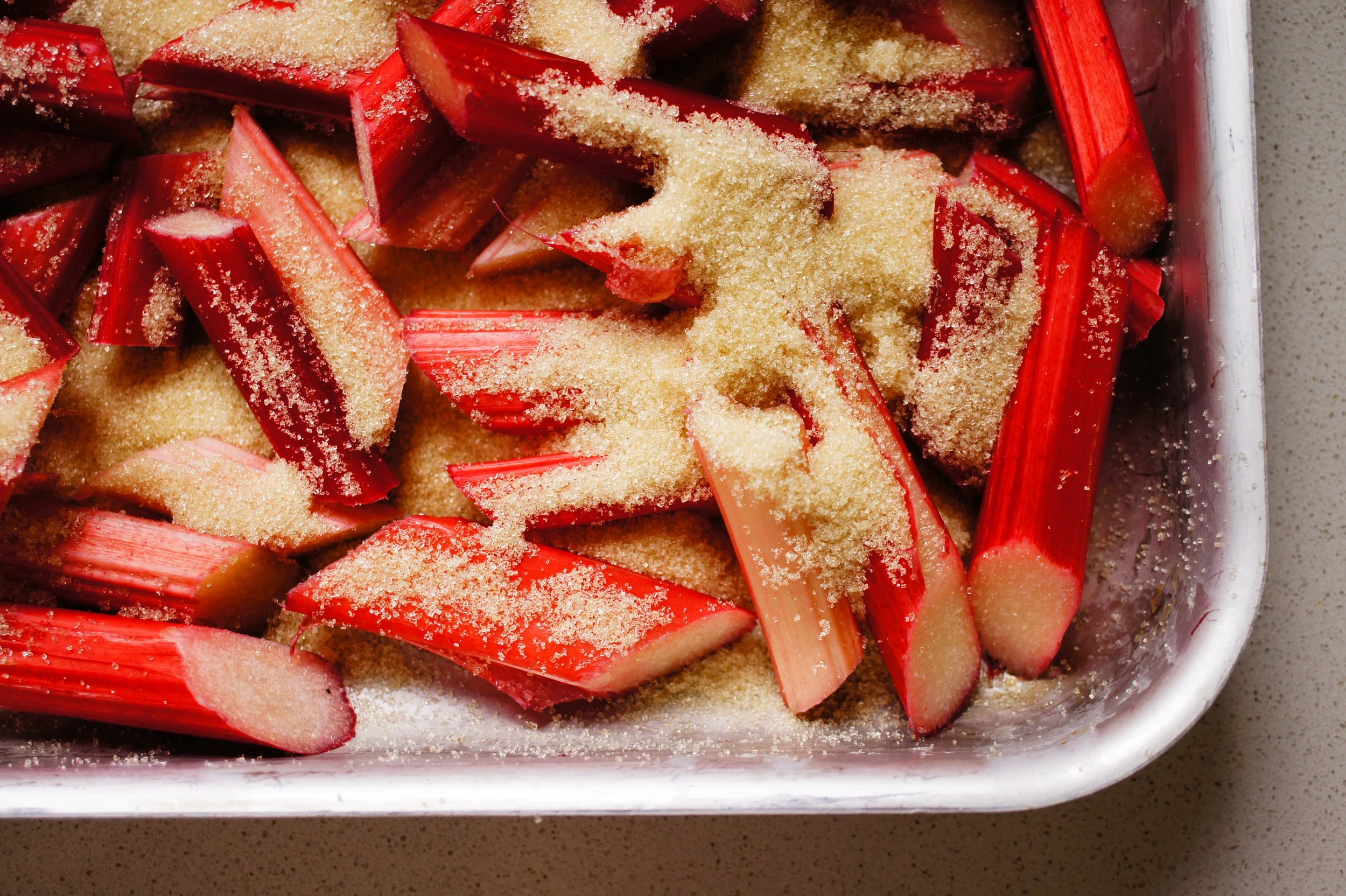
pink rhubarb chopping in a shallow baking tin with caster sugar

There are two rhubarb seasons - one is late winter, early spring, when the crops of pink, forced rhubarb are available, and one is the summer, when the abundant crops of green rhubarb are endlessly sprouting stalks in veg patches and borders up and down the land.

This recipe is designed for the former, the pink kind, particularly if you intend to serve the compote appetisingly atop a crepe, yoghurt or cake. While the green summer kind will taste exactly the same, it will not have the aesthetic appeal of the pink winter version, especially if you want to turn the puree into some other topping like on a cheesecake.

If you only want it for the flavour and don’t need any of the colour, this recipe will produce the same result either which way.

My recipe below is my own.


PORTION SIZE

Makes about 700ml – roughly the amount of 2 large mugs.

TOOLS

Other than the typical kitchen equipment, you will need:

  • a roasting tin with sides, about 4-5cm deep

INGREDIENTS

600g rhubarb (about 10 stalks) **forced, pink ones will make a pink compote; the green summer rhubarb will be a sludgy green colour

100g golden caster sugar

1 to 1 ½ tsp rose water

1-2 drops pink food colouring (optional)

Ratios

  • 100% fruit, 15% sugar

  • Approx. ½ tsp rose extract per 300g fruit

Variations

  • with orange or lime zest – omit the rose water and zest the citrus fruit onto the compôte just after it comes out the oven. Stir to combine.

  • with strawberries — swap half the rhubarb for strawberries

  • With vanilla – stir 2 tsp vanilla paste onto the compôte just after it comes out the oven. Stir to combine.

  • With rosé wine or liqueurs – add 2 tbsp rose wine, elderflower liqueur, Grand Marnier, Chambord etc. to the roasting tin with the raw rhubarb and sugar. Roast together.

  • With cardamom – grind the seeds of 4 cardamom pods and add to the roasting tin with the raw rhubarb and sugar. Roast together. Omit the rose water.


METHOD

Heat oven. Preheat the oven to 180°C fan

Prep rhubarb and any extras. Cut the rhubarb into large chunks and place in a roasting tin with the sugar. If any of your extras need to go in before roasting, add here.

Roast. Cover with foil and cook for 15‐20 minutes or until the rhubarb is tender and the sugar has dissolved into a lovely pink syrup. Expect it to be pretty wet.

Finish. Stir in the rosewater (or any other optional extras, and a drop or two of pink food colouring if you want to amp up the colour), then spoon into a bowl and set aside to cool completely.


USES

  • Dollop onto rice pudding, porridge or crepes

  • Blend into a smoothie

  • Use as a fruit puree for cheesecake topping

  • Serve alongside a cake (particularly a dense type of cake such as a Madeira cake or olive oil cake)

Read More
France, Eat, Summer Frances Lawrence France, Eat, Summer Frances Lawrence

Apricot jam

Recipe for homemade apricot jam - more apricot than sugar. Making a taste of France at home.

Apricots have such a short season that it feels like a real imperative to preserve their flavour during summer and the house will smell divine doing so. Tangy, sparkling and fragrant, to me, apricot jam is one of the tastes of France. To have some on hand has the power to transport me to a warm summer’s afternoon in the Loire Valley when really, I’m scoffing it on a slice of toast on a wet and grey November morning in Yorkshire. The trick is storing it away in a place I forget about it so that I don’t eat it all during the summer.

My recipe below is derived and modified from an original by Pam the Jam.


PORTION SIZE

Makes 2x medium jars (about 400-500ml)

TOOLS

Other than the typical kitchen equipment, you will need:

  • a ladle

  • a metal jam funnel (this will make it a lot easier to only get jam into the jars and not down the sides)

INGREDIENTS

500g underripe or just ripe apricots

275g sugar (granulated or preserving)

4g powdered pection

12ml lemon juice (about half a lemon’s worth)

A drop or two of grapeseed oil (if needed)

Ratios

  • 100% fruit, 55% sugar

  • approx 2g pectin per 150g sugar

Many recipes suggest a 1:1 ratio of fruit to sugar but this blanket statement is useless and I find this far far too sweet. For apricots, roughly 55% sugar to fruit, I find, makes a jam that tastes much more of the fruit than the sugar.

You can use the above ratios to tailor your portion to however much fruit you have available to preserve.


METHOD

Prep fruit - Rinse the apricots, destone them and cut them into quarters.

NOTE! It is often considered more ‘traditional’ that the apricots are halved so that they retain a bit of size and chunk after cooking, but I prefer a more spreadable jam where the fruit has been much softened in the process of cooking, hence my instruction to quarter the fruit.

Macerate fruit - Place the apricots in the jam pot (not too large – jam reduces, which, if it’s too shallow in the pan, makes it hard to get an accurate temperature and can encourage burning). Weigh the sugar, pectin and lemon juice straight into the pan with the apricots, mix to distribute. Cover and let macerate overnight for the juices to draw.

************** WAIT OVERNIGHT ***************

Sterilise jars - First, preheat the oven to 110°C and set out a clean cotton tea towel/dish towel (not terry cloth) on the counter and put a small saucer in the fridge or freezer. Wash the jars and lids in hot soapy water and rinse but don’t dry them. Place the jars onto a baking tray and into the oven for the duration of the jam cooking - If you are using jars with rubber seals, be sure to remove these before placing in the oven and if you have separate lids, place them in a bowl of boiling water.

NOTE! When adding food to the jars, it is necessary that both the food and jars are at the same temperature so that the jars don’t crack, and the jam doesn’t heat up any more when it goes into the jar.

Bring jam up to boil - Place the pan with the jam on the stove over medium heat and allow it to come to a boil — it might look very foamy at this point – don’t worry about it.

Rolling boil - Allow to boil for 15-20 minutes until set, stirring occasionally. Use a thermometer for the best control over the progress – jam sets between 104°C and 105°C. It will be a rich orange once ready, and the sound changes from a wet ‘pop’ to more of a ‘burble’. This fruit doesn’t set quite so readily, so for a spreadable jam, I prefer to take it up to 105°C.

Remove from the heat as soon as it hits 105°C anywhere in the pan and lightly stir in the same direction to remove any foam, adding a drop or two of oil if it doesn’t dispel easily.

Ladle into pots - Now comes the crucial moment. While the jam is still extremely hot — in other words, right away — ladle it into the clean pots, leaving a margin of about half an inch (2 cm) between the top of the jam and the top of the jar. Immediately place the lids on the jars. Quickly wipe off the jars with a sponge to remove any jam on the sides. Using a tea towel to protect your hands from the heat, screw the lids on as tightly as possible.


LET COOL FOR SEVERAL HOURS BEFORE TRYING!


USES

  • Dollop onto rice pudding or porridge

  • Spread onto toast after butter

  • Swirl through a cheesecake

  • Smear onto warm scones or hotcakes

  • In thumbprint cookies

  • As a filling for Victoria Sponge Cake

  • In a nut butter and jam sandwich

Read More