Workings of a Garment: a 1950’s rose-print cotton gown
Study and analysis of how this summer gown was constructed.
Brand & Era
Selfridges (emulating Nina Ricci)
1950’s
Fabric type & weight
cotton, printed or possibly chintz
estimate 160-180gsm
NOTES FOR A DRESSMAKER
Fit - This is a close-fitting garment. Almost all fit is achieved through the princess seams, with only two darts at the side waist. Rather cleverly, given that this is a ready-made garment, the pleated section over the bust would disguise any less-than-perfect fit issues around the bust, making it wearable by different cup sizes without detracting from the finished look.
Panels - 8 total panels
Zip - metal teeth, cotton tape, lapped construction. Hook and thread-eye added across centre of zip to hold the lap down covering the zip, and at the top of the zip for ease of closure.
Seam allowance - very wide, around 1 inch/2.5cm. Much more common for this period, and allows for tailoring and adjustments by the owner for a better fit and longevity as the body changes shape. Also, since this is cotton, any let out seams should not have obvious pinholes if changed.
Interior seam finish - for the bodice, the seam allowance is turned-and-stitched. From the waist down, it is simply pinked. Note also the one clip at the waist to release the concave seam allowance. Considering this garment is around 70 years old, this simple and easy finish is clearly durable enough for this type of garment, in this type of fabric. No evidence of fraying (and I myself have worn this garment at least 8 times in the past few years).
Hem - evidence of original hem being very narrow 3mm double-fold hem, but a previous owner has hemmed again to shorten, fairly neatly but not as neat as the original.
Hand-finishing - thread loops would have been done by hand, and the pleated detail across the bust is also hand-tacked down in key places.
Notable absenses - no lining, no interfacing on any section, and no waist-stay (which I actually think would be very useful and protect the seams from any stress on such a fitted item.
Other Cotton Garments
Square neck tiered midi dress in Liberty Heidi cotton poplin
Perfected the fit, and finally making with an expensive fabric, Liberty’s cotton poplin. Detailed dressmaking closeups.
TOTAL TIME COMMITMENT: 17 hours
Toile (without zip, lining, interior seam finishing, basting stitch removal or hemming): none
Cut out & transfer all pattern markings: 3 hours
Main construction: 10 hours
Lining construction, attachment and hemming: none
Finishings (hem, enclose zip): 2.5 hours
Fabric type
Cotton poplin (Liberty)
Fabric weight
110gsm
ADDITIONAL SEAM FINISHING, CONSTRUCTION NOTES & EXTRAS
Cut out four of the sleeve frills, so that you see the print on both sides
Overlock each edge of skirt pattern piece before construction, press open
Overlock raw edges together at gathered tier seam
Overlock raw edges separately before construction on zip seam
Attach bodice facing to rest of garment using stitch-in-the-ditch
VERDICT & LESSONS LEARNT
A truly beautiful dress, perfectly fit at the bodice, bust and shoulder. I have worked so hard on this pattern, I now have two fit versions - one as a pinafore, fit to go over a top, and a closer fitting option (as here) to be worn alone.
The amendment to cut four of the sleeve frills really elevates the finish, where you see a printed face on the underside and upperside of the frill.
The only error is where I have managed to mis-align the top of the zip slightly, which I think is due to sewing the centred zip in one continuous line from neck edge, around bottom, to neck edge. In the future, I plan to sew each side from neck edge down to bottom of zip, sewing twice over the bottom for reinforcement.
Having made the garment multiple times has really paid off, and my technique is improving, which I can see here in this garment. Perhaps my proudest make ever, tied with the wool flannel shirt I made for my partner.
A beautiful addition to my summer wardrobe and one that I am extremely pleased and proud to wear.
Travel itineraries for Summerwear
Workings of a Garment: a Y2K Acne oversized long-line shirt
Learnings and inspiration for improving my dressmaking up to designer ready-to-wear standards.
Brand & Era
Acne
Y2K, 2013
Fabric type & weight
cotton poplin
estimate 140gsm
STYLE NOTES FOR A PETITE
This is not flattering on my petite frame - too much volume across the dropped shoulder, too much volume at the lower front, too much length overall in both bodice and sleeve.
It is the correct size for me (36) but it just goes to show why oversized is such a difficult silhouette to buy ready-made for a petite, particularly in designerwear, which seems to be sized for a 5’ 8” woman. Trying garments like this makes me more determined to get better and better at making my own oversized or loose-fitting garments.
Oversized is still a fit! Darts need to be in the right place, the volume needs to be proportionate, and it should all be balanced with subtle details that hint or show the figure underneath - such as cut-in shoulders, a tightly fitted cuff, a waist cut-out, or a bare arm or leg.
Other Oversized or Loose-fitting Garments
Puff-sleeve midi dress in khaki green linen-cotton twill from 1970’s pattern
Fourth make with this pattern, following several refinements on fit and pattern instructions.
TOTAL TIME COMMITMENT: 20 hours
Toile (without zip, lining, interior seam finishing, basting stitch removal or hemming): none
Cut out & transfer all pattern markings: 3 hours
Main construction: 11 hours
Lining construction, attachment and hemming: none
Finishings (hem, enclose zip): 2.5 hours
Applying studs: 2.5 hours
Fabric type
Cotton-linen twill
Fabric weight
estimate 250-300gsm
ADDITIONAL SEAM FINISHING, CONSTRUCTION NOTES & EXTRAS
Overlock each edge of skirt pattern piece before construction, press open
Overlock raw edges together at gathered tier seam
Overlock raw edges separately before construction on zip seam
Attach bodice facing to rest of garment using stitch-in-the-ditch
VERDICT & LESSONS LEARNT
For a centred zip, I must not sew the whole thing around in one continuous line - this is what made the top of the zip and the seam go out of alignment
Travel itineraries for Autumnwear
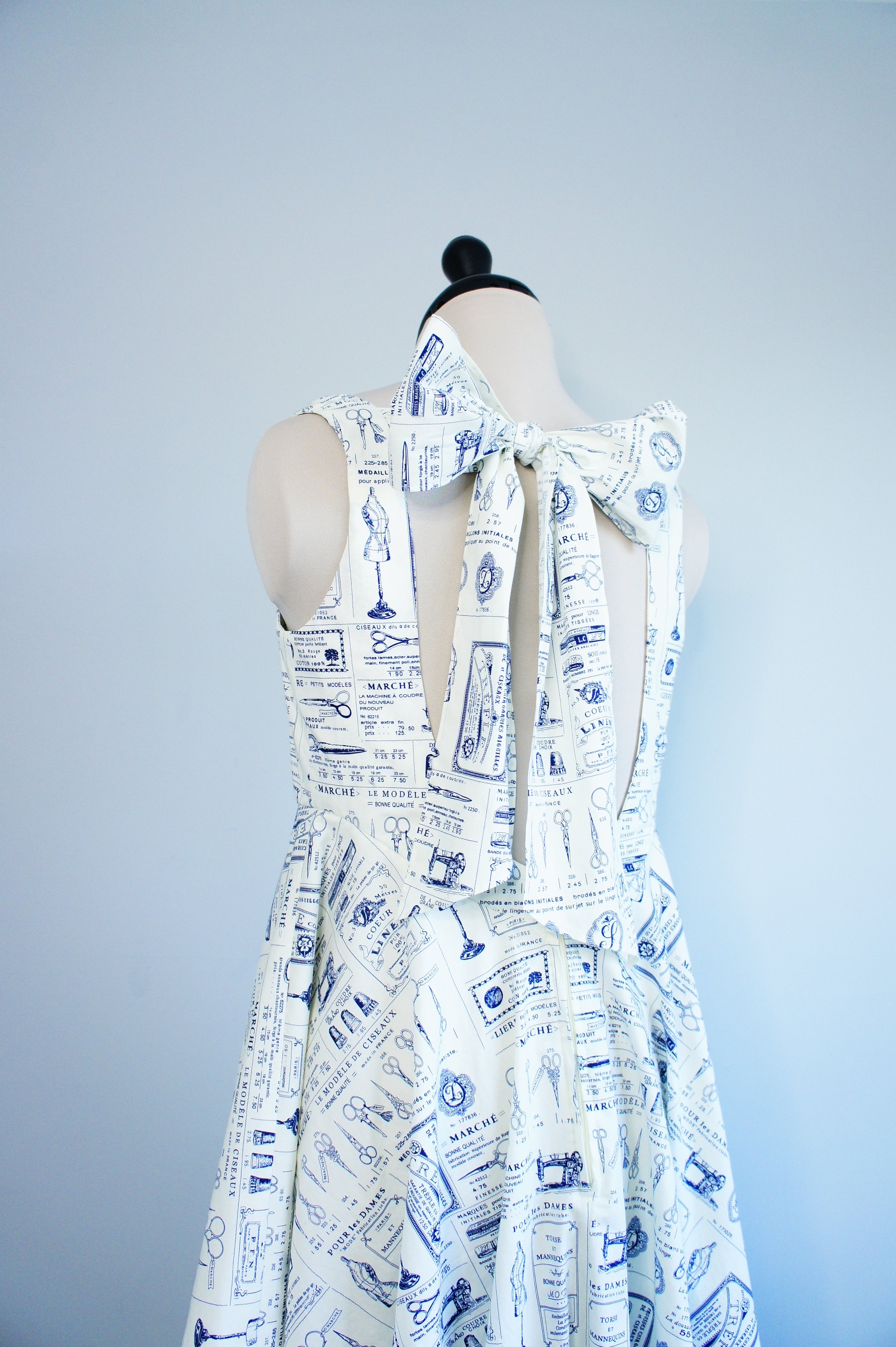
Boat neck summer dress with tie back in a novelty print cotton
Journal of making a dress with boat-neck, shaped underbust seam and large tie bow at the back.
TOTAL TIME COMMITMENT: 10.5 hours without toile (note this dress is unlined)
Cut out & transfer all pattern markings: 2.5 hours
Main construction: 6 hours
Lining construction: none
Finishings (hem): 2 hours
PATTERN CHANGES
None
SEAM FINISHING & DECORATIVE EXTRAS
Skirt side seams – French sea
Super narrow double-fold hem – beautiful finish
VERDICT & LESSONS LEARNT
The biggest lesson I learnt making this, is that sometimes, an adjustment for my narrow shoulders needs to come from the centre front, to bring both shoulders closer to one another, rather than simply making the shoulder seam itself thinner. The boat neckline of this dress should be ideal on me, but it’s much too wide, meaning the narrow shoulder sections want come in and settle further on my natural shoulder, creating a bunch of excess fabric at the centre neck. I also find that with this fit issue, the armscye is too far over onto my arm, restricting movement. None of this would be fixed by my narrowing, or even sloping the shoulder (common adjustments for me) – instead, this needs a narrowing of the whole neckline, then perhaps adding what I have narrowed, onto the side seam, to keep the overall correct width at the bust and underbust.
This is a full circle skirt and that can create a challenge for cutting out on a fabric which has a print with a very obvious right-way-up, as in this one here
VARIATION IDEAS FOR ANOTHER MAKE
Make this in linen, or a linen viscose blend
Travel Itineraries for Summerwear
Button-up box-pleat skirt from McCalls 7906
Lessons learnt from making a box-pleated midi skirt, in a midweight twill, using a Y2K pattern.
TOTAL TIME COMMITMENT: 8 hours
Toile: 3 hours
Cut out & transfer all pattern markings: 2 hours
Main construction: 7.5 hours
Lining construction: none
Finishings (hem): 4.5 hours
ADDITIONAL SEAM FINISHING & DECORATIVE EXTRAS
Overlocked each side of the side seam before stitching
Used a triple stitch for the deep hem, instead of changing to a topstitch thread
Rounded buttonholes
VERDICT & LESSONS LEARNT
I do not like this fabric – too bright, too stiff. I will not wear this skirt.
Also, the fabric is waaaaay too heavy for this amount of box pleating. The area at the waist is particularly bulky and the facing has a tendency to roll outwards. The unusual thing here is that the suggested fabrics are Sateen, Chino, Cotton Blends and Twill. For me, this skirt must be made in a lightweight fabric such as poplin, shirting or lawn.
For all this box pleating and bulkiness, I don’t need pockets; adds too much bulk at the hip area.
Other Skirt Sewing projects
A-line skirt in electric blue cotton twill from Vogue 7210
Midi skirt with contour waistband, using a Y2K Style pattern. Experimenting with a robust and stiff fabric for this design.
TOTAL TIME COMMITMENT: 8 hours
Toile: 3 hours
Cut out & transfer all pattern markings: 1 hour
Main construction: 2.5 hours
Lining construction: none
Finishings (hem): 1.5 hours
ADDITIONAL SEAM FINISHING & DECORATIVE EXTRAS
Each side of the seam allowance was overlocked before stitching
VERDICT & LESSONS LEARNT
A very easy thing to make but do not like this fabric – too bright, too stiff. Will not wear this skirt
Not a bad fit but could need a few tweaks for different fabrics as it sits just a tad low on my waist.
For a sturdier fabric might be better to taper the waist a little without changing the hips
For a finer or more delicate fabric, this is the correct fit
Princess seamed dress with short puff-sleeves from 1980’s Style 4603 pattern
First time sewing princess seams, first time sewing with proper shirting fabric.
TOTAL TIME COMMITMENT: 37 hours including toile
Toile & pattern fitting: 15 hours
Cut out & transfer all pattern markings: 2 hours
Main construction: 9.5 hours
Lining construction, attachment and hemming: none
Finishings (attach buttons, make button holes, hem sleeve and hem skirt): 9.5 hours
PATTERN CHANGES
Deepened the scoop neckline
Changed the patch pockets to pockets concealed in the front skirt seams
SEAM FINISHING & DECORATIVE EXTRAS
Princess seams on bodice – overlock together
Armscye & attach skirt to bodice – overlock together
Skirt seams – overlock together
Shoulder seam – Overlock each side separately
Sleeve seam – Overlock each side separately
Facing edge – bias bind raw edge
Topstitch sleeve hem
Handworked buttonholes
VERDICT & LESSONS LEARNT
This is my first princess-seamed garment, and I spent a loooooong time analysing the fit on the toile, pinching out excess and transferring the adjustments to the paper pattern. In the end, this amounted to removing some excess both just above and just below the waist to account for my hollows, a slight decrease in the shoulder width, and a slight tapering in at the underarm. This is probably the very first garment I have made so many fit adjustments to, and even though this process took quite a while, and the adjustments were really quite small, I am thrilled with the result. It fits me so well, especially around the shoulder and bustline, and hence, looks so lovely on me.
I liked working with the shirting fabric. The Panama weave is quite a loose airy weave, and I find the resulting fabric has that kind of floppy lived-in chic of linen, perfectly suited for wearing on a warm summer’s day.
Other Dress Sewing Projects
A floral needlecord dress from 1970’s Style 1169 pattern
Third make with this pattern, following several refinements on fit and pattern instructions.
TOTAL TIME COMMITMENT: 17.5 hours
Cut out & transfer all pattern markings: 3 hours
Main construction: 12 hours
Lining construction: none
Finishings (buttons, hem): 2.5 hours
ADDITIONAL SEAM FINISHING, CONSTRUCTION NOTES & EXTRAS
Vertical interior seams – overlock
Raw edges on zip seam – overlock each side separately
Raw edges at gathered seam - overlock
Attach bodice facing to rest of garment – stitch-in-the-ditch
VERDICT & LESSONS LEARNT
This fine needlecord is surprising substantial, offering a slight bit of warmth for a Northern European spring summer. The length and amount of fabric also contributes to this, making it something I can wear more readily in England, for our temperate climate.
Travel itineraries for Springwear
Cotton lawn dress from Givenchy 1970’s Vogue Paris Original 1950 pattern
Shortening a 1970’s Givenchy pattern I have worked with before, turning midi into mini, my journal on making this dress in Pima cotton lawn in a busy print.
TOTAL TIME COMMITMENT: 20.5 hours
Cut out & transfer all pattern markings: 5 hours
Main construction: 10 hours
Lining construction: none
Finishings (buttons, hem): 5.5 hours
ADDITIONAL SEAM FINISHING, CONSTRUCTION NOTES & EXTRAS
4x side seams, armscye & pocket bags – bias bind together
Pocket-to-dress seam – French seam
Underarm – French seam
Shoulder seam – bias bind each side separately
Sleeve seam – French seam
VERDICT & LESSONS LEARNT
I find this fabric a bit ‘busy’ for my liking though I can’t pinpoint why………..I also think it really needs to be made in a plain fabric to really see those beautiful released tucks down the bodice.
VARIATION IDEAS FOR ANOTHER MAKE
Add a collar, turning the original mandarin collar into a collar stand?
Make in teal single wool crepe
Turn the sleeve into a half sleeve
Sewing Other Springwear
A spring coat in moss green cotton-linen twill from 1960’s Simplicity 5984 pattern
There’s an absense of outerwear for spring that actually offers warmth but isn’t made from wool. My journal on making my first fully lined spring coat, with cotton flannel interlining for warmth.
TOTAL TIME COMMITMENT: 28 hours including toile
Toile (without buttons, lining, interior seam finishing, basting stitch removal or hemming): 5 hours
Cut out & transfer all pattern markings (both main fabric, facing and lining): 5 hours
Main construction: 11.5 hours
Lining construction: 1.5 hours
Finishings (buttons, button holes, hem): 5 hours
FIT ADJUSTMENTS
Tapered the shoulder seam at a slightly more sloping angle for a better fit at my (sloped) shoulder
SEAM FINISHING
No real seam finishing needed - lined garment
Attach collar neck edge to each other – stitch-in-the-ditch by hand
DECORATIVE EXTRAS & CHOICES
Contrast fabric for the pleat underlay, the facings and the button holes
Contrast colour for the topstitch thread
Omit topstitching at the collar and omit topstitching around the button holes
VERDICT & LESSONS LEARNT
The fit and length on this coat (the shorter version) is superb – just a very small bit of extra sloping at the shoulders was needed to tailor the fit perfectly to my frame.
I absolutely love this fabric – makes such a beautiful jacket with both structure and drape, and very very easy to sew.
I can now make bound button holes! Uncorded, but still – found a technique that works reliably. There are two key things to remember: 1. When cutting, make the side triangles as big as they can be 2. Sew the triangles to the buttonhole fabric in the same colour as the fabric, to prevent it being seeing through the underside of the buttonholes
I can also topstitch much better! I used Gutermann topstitch thread on top with a 90 topstitch needle, and regular all-purpose thread in the bobbin, and I found a stitch length of about 3 to be ideal – worked well!
VARIATION IDEAS
Make in blue and orange Ventile with taped hems and ribbed cuffs, for a more waterproof version
Make a version in a light colour with a dark topstitch
Other Sewing Projects from Vintage Patterns
An A-line skirt in Designer’s Guild cotton duck
Experimenting with Designer’s Guild upholstery fabric………..I asked myself: ”how well can cotton duck be applied to dressmaking?”……..what I learnt
TOTAL TIME COMMITMENT: 10 hours
Toile: none
Cut out & transfer all pattern markings: 1 hour
Main construction: 6 hours
Lining construction: none
Finishings (hem): 3 hours
ADDITIONAL SEAM FINISHING & DECORATIVE EXTRAS
Added 4 rows of topstitching to each vertical seam on the skirt, mainly as a way to enclose the raw edges on the inside
Bias-bound hem
Bias-bound pocket bags
VERDICT & LESSONS LEARNT
I do not like the final product – fabric is easy to sew, but it’s far too stiff to wear.
Still not managing to fit the waistband correctly – this has turned out too big again at 30”. Need a better technique for fitting the waistband to ensure the finished garment is a perfect fit on me.
VARIATION IDEAS
I would like to try it again in a much more lightweight fabric (perhaps even a slightly sheer in a double layer?)
Other Skirt Sewing Projects
High-waisted trousers in sage green twill from a 1970’s Vogue 1275 pattern
Journal of my total make time, lessons learnt and pattern adjustments.
TOTAL TIME COMMITMENT: 9 hours
Toile (without zip, buttons, lining, interior seam finishing, basting stitch removal or hemming): none
Cut out & transfer all pattern markings (both main fabric and interlining): 1 hour
Main construction: 6 hours
Lining construction: none
Finishings (hem): 2 hours
PATTERN CHANGES
Added a little extra flare from the hip down to the hem
Cut the waistband so that the gap and zip is located in the centre back rather than centre front
Add a cuff at the trouser hem
Removed pockets
SEAM FINISHING & DECORATIVE EXTRAS
Outside leg seams – overlock together
Inside leg seams – overlock together
Crotch – overlock each side separately
VERDICT & LESSONS LEARNT
These are great! Turning the waistband around, removing the pockets and adding more flare has made a big enough difference to the finished result that it feels like a very different pair of trousers from my caramel linens.
The cotton twill is a great application for this kind of garment – there is some drape in this fabric so it feels soft and moves nicely, but it also has some structure which adds drama to the flare and is handy in a trouser. I also absolutely had no need to line them.
They also felt very quick and easy to make.
Travel Itineraries for Autumnwear
Square neck pinafore dress in navy blue needlecord
Made as a gift. Details on total make time, adjustments and lessons learnt.
TOTAL TIME COMMITMENT: 34.5 hours including toile
Toile (without zip, lining, interior seam finishing, basting stitch removal or hemming): 12 hours
Cut out & transfer all pattern markings: 3 hours
Main construction: 12 hours
Lining construction, attachment and hemming: 4 hours (optional)
Finishings (hem, enclose zip): 3.5 hours (did a baby rolled hem by hand)
SEAM FINISHING & DECORATIVE EXTRAS
Add a lining to the skirt part only
All interior seams – overlock
Attach bodice facing to rest of garment – stitch-in-the-ditch
VERDICT & LESSONS LEARNT
THIS PATTERN IS FANTASTIC! I removed the lower tier to make this a midi dress and this feels so current. The tiers and gathering are also gorgeously generous – makes the garment feel really luxurious.
Needlecord is pretty dreamy to sew, but remember that there is a slight nap when cutting
I used a baby rolled hem with a hand finish and I think it is a beautiful way to finish fine needlecord and one I will use again – adds a really gorgeous touch to an otherwise quite utilitarian fabric.
Quality needlecord can look and feel like velvet – my Mum thought it was velvet when she first saw it.
Corduroy doesn’t necessarily need lining, but the interior is a lightly brushed cotton which can rub and catch on things like tights so better to line it for an autumn/winter garment.
I overlocked the acetate/rayon lining but I didn’t particularly like the finish – made it quite wibbly. Either need to choose a different technique to finish the raw edge or maybe expand the width of the overlock??
VARIATION IDEAS FOR ANOTHER MAKE
For summer, make a version in a mid- or light-wash denim
Add a contrasting topstitch around the neckline, hem and frill edges??
A loose-fitting tent dress with dagger collar
Working from a 1970’s Style pattern, turning craft cotton to the job of dressmaking - here’s how I got on. Main lesson: oversized is still a fit….
TOTAL TIME COMMITMENT: 18.5 hours including toile (note this dress is unlined)
Toile (without buttons, lining, interior seam finishing, basting stitch removal or hemming): 7 hours
Cut out & transfer all pattern markings: 2.5 hours
Main construction: 5.5 hours
Lining construction: none
Finishings (buttons, hem): 3.5 hours
SEAM FINISHING & DECORATIVE EXTRAS
Around all raw edges – overlock
Handworked buttonholes
VERDICT & LESSONS LEARNT
Oversized is still a fit – while I might not need the kinds of amends that make a garment fit closely to my body, I still need to pay attention to things like dart placement and length, size of armscye, position of shoulder seam etc. If anything, the precision of these details is what makes it look purposefully oversized, and not just a baggy shapeless mess. More so than with fitted garments, I also found myself considering how elements like proportion, fabric drape and hem depth contributed to the overall visual and ensuring that these design aspects offered balance, purpose and structure to the oversized fit. Overall, I loved fitting this oversized garment; it was such an enjoyable experience where I could try out some pattern adjustment techniques and exercise my ‘design eye’ at the same time.
I adore this pattern and the finished garment. As a petite, oversized is a very tricky thing for me to buy ready-made – they tend to swamp me as they aren’t proportionate for petiteness - and has led me to believe it doesn’t suit me but this project has disabused me of that notion. Being able to proportion the oversized-ness for me personally, I now have a garment that suits me well.
I don’t like the instructions for the interfacing on the inside of the button placket, but haven’t figured out a better option.
VARIATION IDEAS FOR ANOTHER MAKE
Use the facings as a guide to make a version with a cutout back
Make this in a liquid, drapey silk (Crepe-back satin silk?! Dare I?!) with smaller buttons up the front
Eliminate some of the fullness in the skirt, turn the side seams into slits, and make it into a long tunic for a co-ord set with a matching pair of wide-leg trousers
Make it a mini
Other Sewing Projects in Cotton
A cropped jacket in cotton twill from 1980’s New Look 6007 pattern
Using a 1980’s cropped suit jacket pattern as the starting point. Details on total make time, adjustments, seam finishes, and lessons learnt.
TOTAL TIME COMMITMENT: 16 hours including toile (note this jacket is self-lined in the same fabric)
Toile (without buttons, lining, interior seam finishing, basting stitch removal or hemming): 6.5 hours
Cut out & transfer all pattern markings (both main fabric and facing): 2.5 hours
Main construction: 7 hours
Lining construction: none
Finishings (buttons, button holes, hem): none
PATTERN CHANGES
I added a waistband and cuffs – attach to the outermost layer, fold to the inside then stitch-in-the-ditch from the outside
Since I didn’t want to make this with shoulder pads (which the shoulder is designed for) but still wanted a ‘slouchy’ ovesized shoulder fit, I reduced the shoulder length by 2.5cm at shoulder head, grading down the armscye by 15cm
Since this pattern has no lining, I chose to self-line the bodice by simply cutting extra pieces of the main bodice, and applying them in reverse. This very neatly hides all the interior raw edges
SEAM FINISHING & DECORATIVE EXTRAS
Armscye – overlock together
VERDICT & LESSONS LEARNT
This is a fantastic loose fit on me, and is excellent without the buttons. It’s a brilliant summer jacket option in the cotton twill fabric – serves all the same purposes as a denim jacket but a bit different.
These sleeves were incredibly difficult to set in, but I managed it without a single pucker. I took a very long time gathering and pinning in place before sewing, then sewed from the side of the gathers to control that better. The extra careful effort was worth the smooth result.
One thing to note on fit, is that I still think the arms are a little too long for me, which is disappointing for a made-to-measure, and I think it is because when ‘sizing them up’ before sewing, I hadn’t pressed the cuffs down, so they were a little ‘springer’ and higher before sewing and pressing.
I think the cuffs and waistband I added were GENIUS – they really finish this jacket off for me, much more in-keeping with my style at the moment
VARIATION IDEAS
Add just two buttons at the waistband, double-breasted style single row of buttons
More 1980’s style
A drop-waist skirt from 1990’s Style 4987 pattern
Making a drop-waist skirt for a petite frame with high waist-to-hip ratio. Lessons learnt.
TOTAL TIME COMMITMENT: 28 hours including toile (note this skirt is unlined)
Toile (with buttons but no lining, interior seam finishing, basting stitch removal or hemming): 12 hours
Cut out & transfer all pattern markings: 2 hours
Main construction: 8 hours
Lining construction: none
Finishings (buttons, hem): 6 hours
SEAM FINISHING & DECORATIVE EXTRAS
Front to back skirt seam – French seam
Narrow double hem
Handworked buttonholes
VERDICT & LESSONS LEARNT
I have a high waist-to-hip ratio with a generous booty. Drop-waist skirts are not typically something I can buy ready-made so what a dream to be abl to make one for myself. I love the final product.
I also learned how to handwork button holes on this project and I’m so glad – this opens up many many more garment-making opportunities now, and it is something I have been putting off learning and the result is that I have shied away from some patterns.
This fabric I chose is a beautiful thing, and the resulting finished skirt is bold, dramatic, and holds its shape well. However, it is medium to heavy weight, and sewing several layers together means that some seams were both difficult to sew and a bit bulky in the end. In addition, the sturdiness of this fabric could also possibly accommodate a slightly more snug fit, as it won’t be stressed in the same way as a more delicate one would.
There are two interior seams that I had to leave raw as I couldn’t work out any better ways to finish them. One, I pinked; the other I left completely raw. I don’t think this skirt should have a lining so figuring out a neater way to finish the interior will take some thought.
I graded between size 14 and size 16 between the waist and hip line but the fit is still not absolutely perfect. I still find the waist is a little big and for some reason still unknown to me, I found that the yoke was too big for the waistband and had to sew the side seams again to a slightly smaller size before attaching the waistband. Perhaps next time I make this, I should just make the size 14.
I also learnt a little struggling to ease the fullness of the circle skirt into the bottom of the yoke – the pattern piece that needs easing can use a slightly smaller seam allowance and when sewing, I should always sew from the side of the fuller piece to control and prevent puckering.
My machine seemed to really struggle with the tension of the top stitching thread. It always seems the top thread was too loose with lots of loops showing on the underside. The topstitching thread gives great sheen but I might try the upholstery thread next time, see if my machine can handle it better
VARIATION IDEAS
I would like to try it again in a much more lightweight fabric (perhaps even a slightly sheer in a double layer?)

