Square neck tiered midi dress in Liberty Heidi cotton poplin
Perfected the fit, and finally making with an expensive fabric, Liberty’s cotton poplin. Detailed dressmaking closeups.
TOTAL TIME COMMITMENT: 17 hours
Toile (without zip, lining, interior seam finishing, basting stitch removal or hemming): none
Cut out & transfer all pattern markings: 3 hours
Main construction: 10 hours
Lining construction, attachment and hemming: none
Finishings (hem, enclose zip): 2.5 hours
Fabric type
Cotton poplin (Liberty)
Fabric weight
110gsm
ADDITIONAL SEAM FINISHING, CONSTRUCTION NOTES & EXTRAS
Cut out four of the sleeve frills, so that you see the print on both sides
Overlock each edge of skirt pattern piece before construction, press open
Overlock raw edges together at gathered tier seam
Overlock raw edges separately before construction on zip seam
Attach bodice facing to rest of garment using stitch-in-the-ditch
VERDICT & LESSONS LEARNT
A truly beautiful dress, perfectly fit at the bodice, bust and shoulder. I have worked so hard on this pattern, I now have two fit versions - one as a pinafore, fit to go over a top, and a closer fitting option (as here) to be worn alone.
The amendment to cut four of the sleeve frills really elevates the finish, where you see a printed face on the underside and upperside of the frill.
The only error is where I have managed to mis-align the top of the zip slightly, which I think is due to sewing the centred zip in one continuous line from neck edge, around bottom, to neck edge. In the future, I plan to sew each side from neck edge down to bottom of zip, sewing twice over the bottom for reinforcement.
Having made the garment multiple times has really paid off, and my technique is improving, which I can see here in this garment. Perhaps my proudest make ever, tied with the wool flannel shirt I made for my partner.
A beautiful addition to my summer wardrobe and one that I am extremely pleased and proud to wear.
Travel itineraries for Summerwear
Pleated blouse in wool flannel from 1970’s Gunne Sax pattern
After some significant design amendments, made a cropped blouse in micro-houndstooth wool flannel. Lessons learnt.
TOTAL TIME COMMITMENT: 19 hours including toile
Toile (without buttons, lining, interior seam finishing, basting stitch removal or hemming) and pattern amends: 7 hours
Cut out & transfer all pattern markings: 1.5 hours
Main construction: 8.5 hours
Lining construction: none
Finishings (buttons, hem): 2 hours
Fabric type
Wool flannel
Fabric weight
estimate 170gsm
VERDICT & LESSONS LEARNT
Size 11 Junior is an excellent starting size for me – I had to make hardly any adjustments to the neck, chest & shoulder (the usual places I need to adjust). The only thing I needed to do was lower the bottom of the armhole, and shorten the bodice by 1 inch. This pattern already had plenty of room at the bust due to the pleats, and plenty of room at the bicep because of the full sleeve. Had this been more fitted in those areas, doubtless I could have also had to do a full bust and fuller bicep adjustment, but the fit across the back, shoulders and chest is particularly nice.
I also adjusted the placement of the stitching across the pleats, raising them up to be more flattering on my petite frame, and also so that they were not so close to the bust area which caused the fabric to pouch out over my full bust, making me look disproportionately large there.
BUTTON HOLES NEED TO BE VERTICAL ON BLOUSES EXCEPT AT THE COLLAR!! I did them horizontally on this, and they extend beyond the edge of the placket, which I will have to live with, but feel a bit daft since they really should be vertical. It did also occur to me that if a blouse pattern has a defined placket, this determines the max size of button I can use.
Also, I need to remember that my choice of interfacing for anywhere there is going to be buttonholes, is really important. I need to choose a facing that will blend in effortlessly when the buttonholes are cut. I used a white interfacing on this, but because it is a darker fashion fabric, you can see little tufts of white where I have cut for the buttonholes. Not a disaster, but would have been so much better to have used a black interfacing.
This is the heaviest fabric I could use for this design I think, and as a matter of fact, it could look much much better on me in a super lightweight fabric like cotton batiste or crepe-de-chine. Made up, wearing it feels a tiny bit like wearing a jacket, so nice and substantial, but I think I would prefer it in a lighter weight fabric. This fabric would be better suited to a trouser or skirt I think.
I learnt a lot about proportioning a loose fit blouse on my petite frame – when there is quite a bit of extra fabric across the front, I need to be very careful and really, these look best on me as cropped blouses, as I ended up doing with this pattern.
Very pleased to find a use for the decorative stitching, but I didn’t do this in a contrasting thread, so it can hardly be seen on the finished blouse.
VARIATION IDEAS FOR ANOTHER MAKE
Make it in a much more lightweight fabric, perhaps sheer as in the sewing pattern photo.
Make the collar, button placket and cuff with a decorative scalloped edge (pattern pieces drafted)
Or make the collar and cuff inserting a piping or lace trim in a contrast colour to define the edge – this will work beautifully well if the main blouse is made in a plain fabric
Travel itineraries for Autumnwear
Puff-sleeve midi dress in khaki green linen-cotton twill from 1970’s pattern
Fourth make with this pattern, following several refinements on fit and pattern instructions.
TOTAL TIME COMMITMENT: 20 hours
Toile (without zip, lining, interior seam finishing, basting stitch removal or hemming): none
Cut out & transfer all pattern markings: 3 hours
Main construction: 11 hours
Lining construction, attachment and hemming: none
Finishings (hem, enclose zip): 2.5 hours
Applying studs: 2.5 hours
Fabric type
Cotton-linen twill
Fabric weight
estimate 250-300gsm
ADDITIONAL SEAM FINISHING, CONSTRUCTION NOTES & EXTRAS
Overlock each edge of skirt pattern piece before construction, press open
Overlock raw edges together at gathered tier seam
Overlock raw edges separately before construction on zip seam
Attach bodice facing to rest of garment using stitch-in-the-ditch
VERDICT & LESSONS LEARNT
For a centred zip, I must not sew the whole thing around in one continuous line - this is what made the top of the zip and the seam go out of alignment
Travel itineraries for Autumnwear
A-line skirt in bright red serge wool twill
Using a 1990’s pattern, details on total make time, adjustments and seam finishes, and lessons learnt.
TOTAL TIME COMMITMENT: 6 hours
Toile (with buttons but no lining, interior seam finishing, basting stitch removal or hemming): none
Cut out & transfer all pattern markings: 1 hour
Main construction: 4.5 hours
Lining construction: none
Finishings (hooks, hem): 1.5 hour
ADDITIONAL SEAM FINISHING & DECORATIVE EXTRAS
Each side of the seam allowance was overlocked before stitching
Went with an overlock with single fold hem because I attempted a blind hem, but it didn’t take all the way round, and I didn’t want to unpick it and potentially ruin the overlocking so just stitched it
VERDICT & LESSONS LEARNT
Attached the zip too high up on the centre back seam – have to draw this over my head.
This was an INCREDIBLY easy skirt to sew together and I absolutely love this, what I am calling ‘trench-weight’ wool. It is so smooth, so drapey, great handle, and yet still has a touch of structure. Been wearing it in London today actually and not found it very creasy at all. Looks amazing with my Jaeger navy wool trench which is in a similar fabric.
Other 1990’s Sewing Projects
High-waisted trousers in smooth serge wool twill
Working with a 1970’s Vogue Basic Design pattern, details on total make time, adjustments, seam finishes, and lessons learnt.
TOTAL TIME COMMITMENT: 9.5 hours, no toile (note these trousers are unlined)
Toile (without zip, buttons, lining, interior seam finishing, basting stitch removal or hemming): none
Cut out & transfer all pattern markings (both main fabric and lining): 1.5 hours
Main construction: 6.5 hours
Lining construction: none
Finishings (buttons, hem): 1.5 hours
PATTERN CHANGES
Increased zip length to 8” (for easier clearance over my hips)
SEAM FINISHING & DECORATIVE EXTRAS
Edgestitching at pocket opening
2 ½” hem, made using blind hem
Leg and crotch seams – overlock separately
Pocket bags – overlock together
VERDICT & LESSONS LEARNT
I need to be more careful and choosy about trousers with tucks:
- just because they fit at the waist, they may not be the best fit at the hips. The tucks need to have more room and ease to ‘billow’ over the hips and not cling. I have drafted a pattern with an extra 2 ½” at the hips
- when making a garment with these pleats/tucks, it may be better to fit them to have the waist band sit very slightly below my natural waist, to avoid the tucks ‘poofing’ over my stomach
This weight of wool, I am henceforth going to refer to a ‘trench weight’ wool. It is fine for use on some trousers and skirts, though better application would be a trench coat or a jacket. Its smooth and lovely to wear though, and I don’t find these trousers miss a lining.
VARIATION IDEAS FOR ANOTHER MAKE
Make in a very fluid fabric, such as a viscose crepe or viscose jacquard – should work really well with the pleats at the front, and especially if I lower the waist a teeny bit to sit just below my natural waist
Other 1970’s Sewing projects
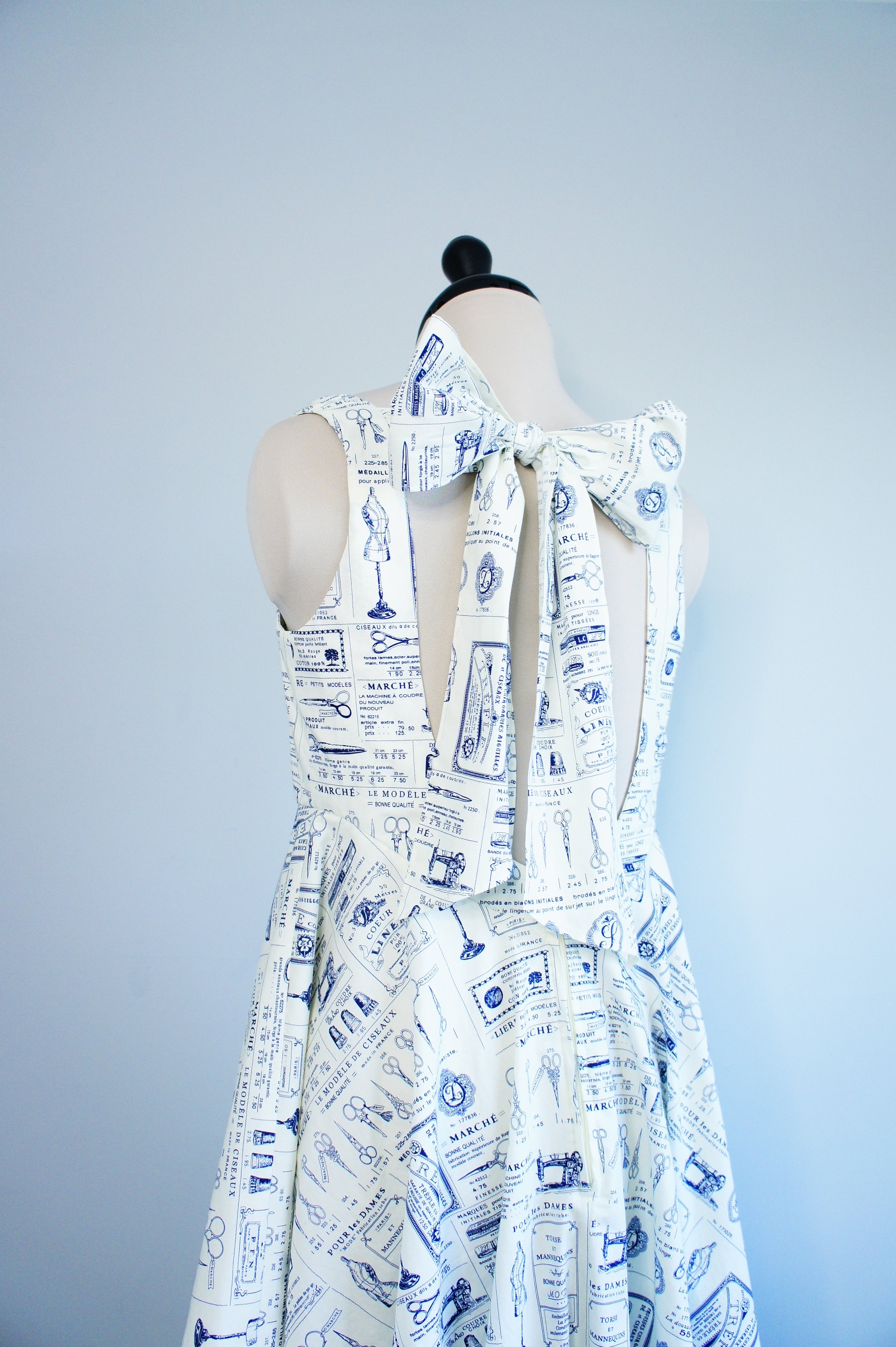
Boat neck summer dress with tie back in a novelty print cotton
Journal of making a dress with boat-neck, shaped underbust seam and large tie bow at the back.
TOTAL TIME COMMITMENT: 10.5 hours without toile (note this dress is unlined)
Cut out & transfer all pattern markings: 2.5 hours
Main construction: 6 hours
Lining construction: none
Finishings (hem): 2 hours
PATTERN CHANGES
None
SEAM FINISHING & DECORATIVE EXTRAS
Skirt side seams – French sea
Super narrow double-fold hem – beautiful finish
VERDICT & LESSONS LEARNT
The biggest lesson I learnt making this, is that sometimes, an adjustment for my narrow shoulders needs to come from the centre front, to bring both shoulders closer to one another, rather than simply making the shoulder seam itself thinner. The boat neckline of this dress should be ideal on me, but it’s much too wide, meaning the narrow shoulder sections want come in and settle further on my natural shoulder, creating a bunch of excess fabric at the centre neck. I also find that with this fit issue, the armscye is too far over onto my arm, restricting movement. None of this would be fixed by my narrowing, or even sloping the shoulder (common adjustments for me) – instead, this needs a narrowing of the whole neckline, then perhaps adding what I have narrowed, onto the side seam, to keep the overall correct width at the bust and underbust.
This is a full circle skirt and that can create a challenge for cutting out on a fabric which has a print with a very obvious right-way-up, as in this one here
VARIATION IDEAS FOR ANOTHER MAKE
Make this in linen, or a linen viscose blend
Travel Itineraries for Summerwear
Man’s shirt in grey wool flannel from Simplicity 8753
Fine wool flannel, from a modern Simplicity pattern. Beautiful shirting fabric, even though few use it this way.
TOTAL TIME COMMITMENT: 18.5 hours (including toile)
Toile (without zip, buttons, lining, interior seam finishing, basting stitch removal or hemming): 7 hours
Cut out & transfer all pattern markings (both main fabric and interlining): 2.5 hours
Main construction: 5.5 hours
Lining construction: none
Finishings (hooks, hem): 3.5 hours
PATTERN CHANGES
None
SEAM FINISHING & DECORATIVE EXTRAS
Topstitch with regular thread & 2.8mm stitch length – lovely, very subtle
Rounded buttonhole – correct choice for fine/medium fabric
VERDICT & LESSONS LEARNT
I adored sewing with this fabric. And it finished up a dream. Will make myself a shirt in wool flannel, for certain.
Flat-felling the seams was easier than I expected and makes a very (unsurprisingly) flat finish on the inside, which I expect enhances the wear experience.
I couldn’t have been prouder of myself of my edgestiching on this make. On point. I’m improving.
Learnt a lot about buttonholing on this project. While certainly less effort than handbound buttonholes, doing them on the machine is not the most straight-forward task, and they can very easily go askew if you are just a tad too assertive when feeding the fabric through the machine.
I don’t like the instructions for the interfacing on the inside of the button placket, but haven’t figured out a better option.
Button-up box-pleat skirt from McCalls 7906
Lessons learnt from making a box-pleated midi skirt, in a midweight twill, using a Y2K pattern.
TOTAL TIME COMMITMENT: 8 hours
Toile: 3 hours
Cut out & transfer all pattern markings: 2 hours
Main construction: 7.5 hours
Lining construction: none
Finishings (hem): 4.5 hours
ADDITIONAL SEAM FINISHING & DECORATIVE EXTRAS
Overlocked each side of the side seam before stitching
Used a triple stitch for the deep hem, instead of changing to a topstitch thread
Rounded buttonholes
VERDICT & LESSONS LEARNT
I do not like this fabric – too bright, too stiff. I will not wear this skirt.
Also, the fabric is waaaaay too heavy for this amount of box pleating. The area at the waist is particularly bulky and the facing has a tendency to roll outwards. The unusual thing here is that the suggested fabrics are Sateen, Chino, Cotton Blends and Twill. For me, this skirt must be made in a lightweight fabric such as poplin, shirting or lawn.
For all this box pleating and bulkiness, I don’t need pockets; adds too much bulk at the hip area.
Other Skirt Sewing projects
A-line skirt in electric blue cotton twill from Vogue 7210
Midi skirt with contour waistband, using a Y2K Style pattern. Experimenting with a robust and stiff fabric for this design.
TOTAL TIME COMMITMENT: 8 hours
Toile: 3 hours
Cut out & transfer all pattern markings: 1 hour
Main construction: 2.5 hours
Lining construction: none
Finishings (hem): 1.5 hours
ADDITIONAL SEAM FINISHING & DECORATIVE EXTRAS
Each side of the seam allowance was overlocked before stitching
VERDICT & LESSONS LEARNT
A very easy thing to make but do not like this fabric – too bright, too stiff. Will not wear this skirt
Not a bad fit but could need a few tweaks for different fabrics as it sits just a tad low on my waist.
For a sturdier fabric might be better to taper the waist a little without changing the hips
For a finer or more delicate fabric, this is the correct fit
Ultra wide leg flat-front trousers from Burda 6966
The simplicity, elegance and sophistication of sewing trousers in single wool crepe.
TOTAL TIME COMMITMENT: 9 hours
Toile (without zip, buttons, lining, interior seam finishing, basting stitch removal or hemming): 4 hours
Cut out & transfer all pattern markings (both main fabric and interlining): 1.5 hours
Main construction: 5.5 hours
Lining construction: none
Finishings (hooks, hem): 1.5 hours
Fabric type
Single wool crepe
Fabric weight
280-300gsm
PATTERN CHANGES
Added a little extra flare from the hip down to the hem
Adjusted the fit by lengthening the crotch
SEAM FINISHING & DECORATIVE EXTRAS
Outside leg seams – overlock together
Inside leg seams – overlock together
Crotch – overlock each side separately
Do a lapped zip, rather than a centred zip
VERDICT & LESSONS LEARNT
Very quick and easy to make.
This is a gorgeous, ultra-simple wide leg, which makes a fabulous pair of trousers, with a very minimal upper section (narrow waistband, no pockets, and zip in the centre back) which is flipping excellent for pretty much anything, but particularly a long line top which I want to style left out – its very smooth underneath the top.
The ultra wide leg of Version A brings the drama when paired with a plain fabric.
The work I did to correct the fit of this pattern, means this is now perfect on me.
Using single wool crepe for this was a BRILLIANT idea. It is fluid, and classy. I also don’t find it needs lining.
Other Ideas for Winter
A tent dress in Liberty crepe-de-chine from Very Easy Vogue 8593
Reflections on the first time working with silk. Main lesson: crepe-de-chine is difficult to cut out…
TOTAL TIME COMMITMENT: 16 hours
Cut out & transfer all pattern markings: 3.5 hours
Main construction: 7.5 hours
Lining construction: none
Finishings (buttons, hem): 5 hours
ADDITIONAL SEAM FINISHING, CONSTRUCTION NOTES & EXTRAS
Interior seams - stitch-and-pink
No buttonholes (didn’t want to risk it on the crepe-de-chine!) Went with faux buttons, with press-studs underneath.
VERDICT & LESSONS LEARNT
This was one of those ‘scary projects’ for me. My first attempt using crepe-de-chine and it was a gift to boot, so the fear about getting it wrong felt real enough to put me off getting it made for a long time - too long. The trigger was reading this great article from Closet Core Patterns, which really cut through and reminded me that I won’t learn anything unless I just get on with it.
What greatly helped, was using a pattern that a. I know I love, b. I know fits me, and c. is quite a simple design. I think it could have gone poorly if I’d attempted to make something in this more difficult fabric whilst also grappling with a new or more challenging pattern. I set myself up with success being a strong possibility.
My main learning was the application of crepe-de-chine needs considering, and some design elements need changing when using it. For example, I don’t think garments made from crepe-de-chine should have pockets. Part of the appeal in this fabric is its featherlightness when wearing, and when you have a pocket, you put something in it….weighing down that airy fluidity you (probably paid so much) to wear. So, the lesson for me is: if I’m intending to make something from crepe-de-chine, skip any pockets on the pattern.
I actually found the cutting out, not the sewing, to be the most challenging aspect of using this fabric. I don’t own a cutting mat or rotary cutter, so it was good old fashioned pins and scissors and this fabric definitely shrinks away from the scissors very readily. While the sewing wasn’t dreamy, it being a matte fabric, it was actually fairly grippy and steady under the machine, more than I expected it to be.
Last learning point was the stitch-and-pink method for finishing interior seams works a treat. OK, not necessarily the sort of finish you get on designer or ready-to-wear, but straight-foward to sew, reliable, and crucially adds no bulk. Its a finish I will use again on this fabric.
In terms of the result, I. Am. Thrilled. I feel like a flipping goddess wearing this garment, and it’s turned out to be a compliment-fetcher too. It’s the epitome of effortless chic, and has me wafting about with the air of a woman who knows what she’s about.
Travel Itineraries for Summerwear
A scoop neck tiered sundress from a 1970’s Butterick 7012 pattern
Going off-piste, using quilting cotton for a simple summer tiered dress with topstitching.
TOTAL TIME COMMITMENT: 7.5 hours
Cut out & transfer all pattern markings: 1.5 hours
Main construction: 5.5 hours
Lining construction, attachment and hemming: none
Finishings (hem): 0.5 hours
PATTERN CHANGES
None
SEAM FINISHING & DECORATIVE EXTRAS
Vertical interior seams – overlock
Raw edges at gathered seam - overlock
Attach bodice facing to rest of garment – stitch-in-the-ditch
VERDICT & LESSONS LEARNT
Very very very simple to make. There are hardly any fit devices on this garment (which also means its not very figure-showing either) and there is no closure - it pulls over the head - so it is very easy to knock togther. This looseness of fit makes it ideal for a very very hot day, or as a cover up over a bikini, both of which I have used it for and its ideal.
I absolutely love the Painters Palette solids quilting fabric as an option for dressmaking. It’s so very easy to sew with, and is ‘substantial’ cotton fabric that is not sheer at all. It seems very hard to find a similar weight cotton in true dress-making fabric.
Did a ‘quick and dirty’ Full-Bust-Adjustment on this bodice, that doesn’t have any darts, by simply lengthening the bodice front and back, then adding two darts. Result is not bad, though darts feel like they are in the wrong place.
VARIATION IDEAS FOR ANOTHER MAKE
I would like the gathering to be more generous than it is – would like to widen each of the tiers to get more gathering into each one
Make in a viscose crepe or a crepe-back satin. The result will be more drapey and the loose fit means seams won’t get stressed.
Other Sewing Projects in Cotton
Princess seamed dress with short puff-sleeves from 1980’s Style 4603 pattern
First time sewing princess seams, first time sewing with proper shirting fabric.
TOTAL TIME COMMITMENT: 37 hours including toile
Toile & pattern fitting: 15 hours
Cut out & transfer all pattern markings: 2 hours
Main construction: 9.5 hours
Lining construction, attachment and hemming: none
Finishings (attach buttons, make button holes, hem sleeve and hem skirt): 9.5 hours
PATTERN CHANGES
Deepened the scoop neckline
Changed the patch pockets to pockets concealed in the front skirt seams
SEAM FINISHING & DECORATIVE EXTRAS
Princess seams on bodice – overlock together
Armscye & attach skirt to bodice – overlock together
Skirt seams – overlock together
Shoulder seam – Overlock each side separately
Sleeve seam – Overlock each side separately
Facing edge – bias bind raw edge
Topstitch sleeve hem
Handworked buttonholes
VERDICT & LESSONS LEARNT
This is my first princess-seamed garment, and I spent a loooooong time analysing the fit on the toile, pinching out excess and transferring the adjustments to the paper pattern. In the end, this amounted to removing some excess both just above and just below the waist to account for my hollows, a slight decrease in the shoulder width, and a slight tapering in at the underarm. This is probably the very first garment I have made so many fit adjustments to, and even though this process took quite a while, and the adjustments were really quite small, I am thrilled with the result. It fits me so well, especially around the shoulder and bustline, and hence, looks so lovely on me.
I liked working with the shirting fabric. The Panama weave is quite a loose airy weave, and I find the resulting fabric has that kind of floppy lived-in chic of linen, perfectly suited for wearing on a warm summer’s day.
Other Dress Sewing Projects
A floral needlecord dress from 1970’s Style 1169 pattern
Third make with this pattern, following several refinements on fit and pattern instructions.
TOTAL TIME COMMITMENT: 17.5 hours
Cut out & transfer all pattern markings: 3 hours
Main construction: 12 hours
Lining construction: none
Finishings (buttons, hem): 2.5 hours
ADDITIONAL SEAM FINISHING, CONSTRUCTION NOTES & EXTRAS
Vertical interior seams – overlock
Raw edges on zip seam – overlock each side separately
Raw edges at gathered seam - overlock
Attach bodice facing to rest of garment – stitch-in-the-ditch
VERDICT & LESSONS LEARNT
This fine needlecord is surprising substantial, offering a slight bit of warmth for a Northern European spring summer. The length and amount of fabric also contributes to this, making it something I can wear more readily in England, for our temperate climate.
Travel itineraries for Springwear
Cotton lawn dress from Givenchy 1970’s Vogue Paris Original 1950 pattern
Shortening a 1970’s Givenchy pattern I have worked with before, turning midi into mini, my journal on making this dress in Pima cotton lawn in a busy print.
TOTAL TIME COMMITMENT: 20.5 hours
Cut out & transfer all pattern markings: 5 hours
Main construction: 10 hours
Lining construction: none
Finishings (buttons, hem): 5.5 hours
ADDITIONAL SEAM FINISHING, CONSTRUCTION NOTES & EXTRAS
4x side seams, armscye & pocket bags – bias bind together
Pocket-to-dress seam – French seam
Underarm – French seam
Shoulder seam – bias bind each side separately
Sleeve seam – French seam
VERDICT & LESSONS LEARNT
I find this fabric a bit ‘busy’ for my liking though I can’t pinpoint why………..I also think it really needs to be made in a plain fabric to really see those beautiful released tucks down the bodice.
VARIATION IDEAS FOR ANOTHER MAKE
Add a collar, turning the original mandarin collar into a collar stand?
Make in teal single wool crepe
Turn the sleeve into a half sleeve
Sewing Other Springwear
A spring coat in moss green cotton-linen twill from 1960’s Simplicity 5984 pattern
There’s an absense of outerwear for spring that actually offers warmth but isn’t made from wool. My journal on making my first fully lined spring coat, with cotton flannel interlining for warmth.
TOTAL TIME COMMITMENT: 28 hours including toile
Toile (without buttons, lining, interior seam finishing, basting stitch removal or hemming): 5 hours
Cut out & transfer all pattern markings (both main fabric, facing and lining): 5 hours
Main construction: 11.5 hours
Lining construction: 1.5 hours
Finishings (buttons, button holes, hem): 5 hours
FIT ADJUSTMENTS
Tapered the shoulder seam at a slightly more sloping angle for a better fit at my (sloped) shoulder
SEAM FINISHING
No real seam finishing needed - lined garment
Attach collar neck edge to each other – stitch-in-the-ditch by hand
DECORATIVE EXTRAS & CHOICES
Contrast fabric for the pleat underlay, the facings and the button holes
Contrast colour for the topstitch thread
Omit topstitching at the collar and omit topstitching around the button holes
VERDICT & LESSONS LEARNT
The fit and length on this coat (the shorter version) is superb – just a very small bit of extra sloping at the shoulders was needed to tailor the fit perfectly to my frame.
I absolutely love this fabric – makes such a beautiful jacket with both structure and drape, and very very easy to sew.
I can now make bound button holes! Uncorded, but still – found a technique that works reliably. There are two key things to remember: 1. When cutting, make the side triangles as big as they can be 2. Sew the triangles to the buttonhole fabric in the same colour as the fabric, to prevent it being seeing through the underside of the buttonholes
I can also topstitch much better! I used Gutermann topstitch thread on top with a 90 topstitch needle, and regular all-purpose thread in the bobbin, and I found a stitch length of about 3 to be ideal – worked well!
VARIATION IDEAS
Make in blue and orange Ventile with taped hems and ribbed cuffs, for a more waterproof version
Make a version in a light colour with a dark topstitch
Other Sewing Projects from Vintage Patterns
A square neck pinafore dress in grey wool from 1970’s Style 1169 pattern
Journal on making a midi dress with a ruffle tier, suitable for an autumn pinafore. Made in light grey wool from a 1970’s pattern.
TOTAL TIME COMMITMENT: 18.5 hours
Cut out & transfer all pattern markings: 3 hours
Main construction: 12 hours
Lining construction, attachment and hemming: none
Finishings (hem, enclose zip): 3.5 hours
SEAM FINISHING & DECORATIVE EXTRAS
Vertical interior seams – french seam
Raw edges on zip seam – overlock each side separately
Raw edges at gathered seam - overlock
Attach bodice facing to rest of garment – stitch-in-the-ditch
VERDICT & LESSONS LEARNT
This dress pattern is equally suitable to lined or unlined.
Choosing the correct construction technique for the hem is important – I used overlocking with a blind hemstitch but upon wearing, I am finding my boot hardware (since that is how I wear it) is catching the loose threads and pulling them. I need to redo the hem with a better technique where this will not happen.
VARIATION IDEAS FOR ANOTHER MAKE
Make a puffball tier at the bottom, rather than a simple gathered tier. The fabric might need interlining with silk organza to maintain the structure of the puffball.
Make in a fine denim, with some embroidery.
Other 1970’s Sewing Projects
An A-line skirt in Designer’s Guild cotton duck
Experimenting with Designer’s Guild upholstery fabric………..I asked myself: ”how well can cotton duck be applied to dressmaking?”……..what I learnt
TOTAL TIME COMMITMENT: 10 hours
Toile: none
Cut out & transfer all pattern markings: 1 hour
Main construction: 6 hours
Lining construction: none
Finishings (hem): 3 hours
ADDITIONAL SEAM FINISHING & DECORATIVE EXTRAS
Added 4 rows of topstitching to each vertical seam on the skirt, mainly as a way to enclose the raw edges on the inside
Bias-bound hem
Bias-bound pocket bags
VERDICT & LESSONS LEARNT
I do not like the final product – fabric is easy to sew, but it’s far too stiff to wear.
Still not managing to fit the waistband correctly – this has turned out too big again at 30”. Need a better technique for fitting the waistband to ensure the finished garment is a perfect fit on me.
VARIATION IDEAS
I would like to try it again in a much more lightweight fabric (perhaps even a slightly sheer in a double layer?)
Other Skirt Sewing Projects
High-waisted trousers in sage green twill from a 1970’s Vogue 1275 pattern
Journal of my total make time, lessons learnt and pattern adjustments.
TOTAL TIME COMMITMENT: 9 hours
Toile (without zip, buttons, lining, interior seam finishing, basting stitch removal or hemming): none
Cut out & transfer all pattern markings (both main fabric and interlining): 1 hour
Main construction: 6 hours
Lining construction: none
Finishings (hem): 2 hours
PATTERN CHANGES
Added a little extra flare from the hip down to the hem
Cut the waistband so that the gap and zip is located in the centre back rather than centre front
Add a cuff at the trouser hem
Removed pockets
SEAM FINISHING & DECORATIVE EXTRAS
Outside leg seams – overlock together
Inside leg seams – overlock together
Crotch – overlock each side separately
VERDICT & LESSONS LEARNT
These are great! Turning the waistband around, removing the pockets and adding more flare has made a big enough difference to the finished result that it feels like a very different pair of trousers from my caramel linens.
The cotton twill is a great application for this kind of garment – there is some drape in this fabric so it feels soft and moves nicely, but it also has some structure which adds drama to the flare and is handy in a trouser. I also absolutely had no need to line them.
They also felt very quick and easy to make.
Travel Itineraries for Autumnwear
Square neck pinafore dress in navy blue needlecord
Made as a gift. Details on total make time, adjustments and lessons learnt.
TOTAL TIME COMMITMENT: 34.5 hours including toile
Toile (without zip, lining, interior seam finishing, basting stitch removal or hemming): 12 hours
Cut out & transfer all pattern markings: 3 hours
Main construction: 12 hours
Lining construction, attachment and hemming: 4 hours (optional)
Finishings (hem, enclose zip): 3.5 hours (did a baby rolled hem by hand)
SEAM FINISHING & DECORATIVE EXTRAS
Add a lining to the skirt part only
All interior seams – overlock
Attach bodice facing to rest of garment – stitch-in-the-ditch
VERDICT & LESSONS LEARNT
THIS PATTERN IS FANTASTIC! I removed the lower tier to make this a midi dress and this feels so current. The tiers and gathering are also gorgeously generous – makes the garment feel really luxurious.
Needlecord is pretty dreamy to sew, but remember that there is a slight nap when cutting
I used a baby rolled hem with a hand finish and I think it is a beautiful way to finish fine needlecord and one I will use again – adds a really gorgeous touch to an otherwise quite utilitarian fabric.
Quality needlecord can look and feel like velvet – my Mum thought it was velvet when she first saw it.
Corduroy doesn’t necessarily need lining, but the interior is a lightly brushed cotton which can rub and catch on things like tights so better to line it for an autumn/winter garment.
I overlocked the acetate/rayon lining but I didn’t particularly like the finish – made it quite wibbly. Either need to choose a different technique to finish the raw edge or maybe expand the width of the overlock??
VARIATION IDEAS FOR ANOTHER MAKE
For summer, make a version in a mid- or light-wash denim
Add a contrasting topstitch around the neckline, hem and frill edges??