A Journal

A personal journal that invites readers to design their own journeys through the world - with travel, dress and taste.

Search Posts:

Jump to

Travel

Jump to

Wardrobe

Jump to

Eat

Wardrobe, Spring Frances Lawrence Wardrobe, Spring Frances Lawrence

Workings of a Garment: a 1950’s rose-print cotton gown

Study and analysis of how this summer gown was constructed.


Brand & Era

Selfridges (emulating Nina Ricci)

1950’s

Fabric type & weight

cotton, printed or possibly chintz

estimate 160-180gsm

NOTES FOR A DRESSMAKER

Fit - This is a close-fitting garment. Almost all fit is achieved through the princess seams, with only two darts at the side waist. Rather cleverly, given that this is a ready-made garment, the pleated section over the bust would disguise any less-than-perfect fit issues around the bust, making it wearable by different cup sizes without detracting from the finished look.

Panels - 8 total panels

Zip - metal teeth, cotton tape, lapped construction. Hook and thread-eye added across centre of zip to hold the lap down covering the zip, and at the top of the zip for ease of closure.

Seam allowance - very wide, around 1 inch/2.5cm. Much more common for this period, and allows for tailoring and adjustments by the owner for a better fit and longevity as the body changes shape. Also, since this is cotton, any let out seams should not have obvious pinholes if changed.

Interior seam finish - for the bodice, the seam allowance is turned-and-stitched. From the waist down, it is simply pinked. Note also the one clip at the waist to release the concave seam allowance. Considering this garment is around 70 years old, this simple and easy finish is clearly durable enough for this type of garment, in this type of fabric. No evidence of fraying (and I myself have worn this garment at least 8 times in the past few years).

Hem - evidence of original hem being very narrow 3mm double-fold hem, but a previous owner has hemmed again to shorten, fairly neatly but not as neat as the original.

Hand-finishing - thread loops would have been done by hand, and the pleated detail across the bust is also hand-tacked down in key places.

Notable absenses - no lining, no interfacing on any section, and no waist-stay (which I actually think would be very useful and protect the seams from any stress on such a fitted item.


Other Cotton Garments

Read More
Wardrobe, Spring Frances Lawrence Wardrobe, Spring Frances Lawrence

Workings of a Garment: a Y2K Acne oversized long-line shirt

Learnings and inspiration for improving my dressmaking up to designer ready-to-wear standards.

Brand & Era

Acne

Y2K, 2013

Fabric type & weight

cotton poplin

estimate 140gsm

STYLE NOTES FOR A PETITE

This is not flattering on my petite frame - too much volume across the dropped shoulder, too much volume at the lower front, too much length overall in both bodice and sleeve.

It is the correct size for me (36) but it just goes to show why oversized is such a difficult silhouette to buy ready-made for a petite, particularly in designerwear, which seems to be sized for a 5’ 8” woman. Trying garments like this makes me more determined to get better and better at making my own oversized or loose-fitting garments.

Oversized is still a fit! Darts need to be in the right place, the volume needs to be proportionate, and it should all be balanced with subtle details that hint or show the figure underneath - such as cut-in shoulders, a tightly fitted cuff, a waist cut-out, or a bare arm or leg.


Other Oversized or Loose-fitting Garments

Read More
Wardrobe, Summer, Dressmaking Frances Lawrence Wardrobe, Summer, Dressmaking Frances Lawrence

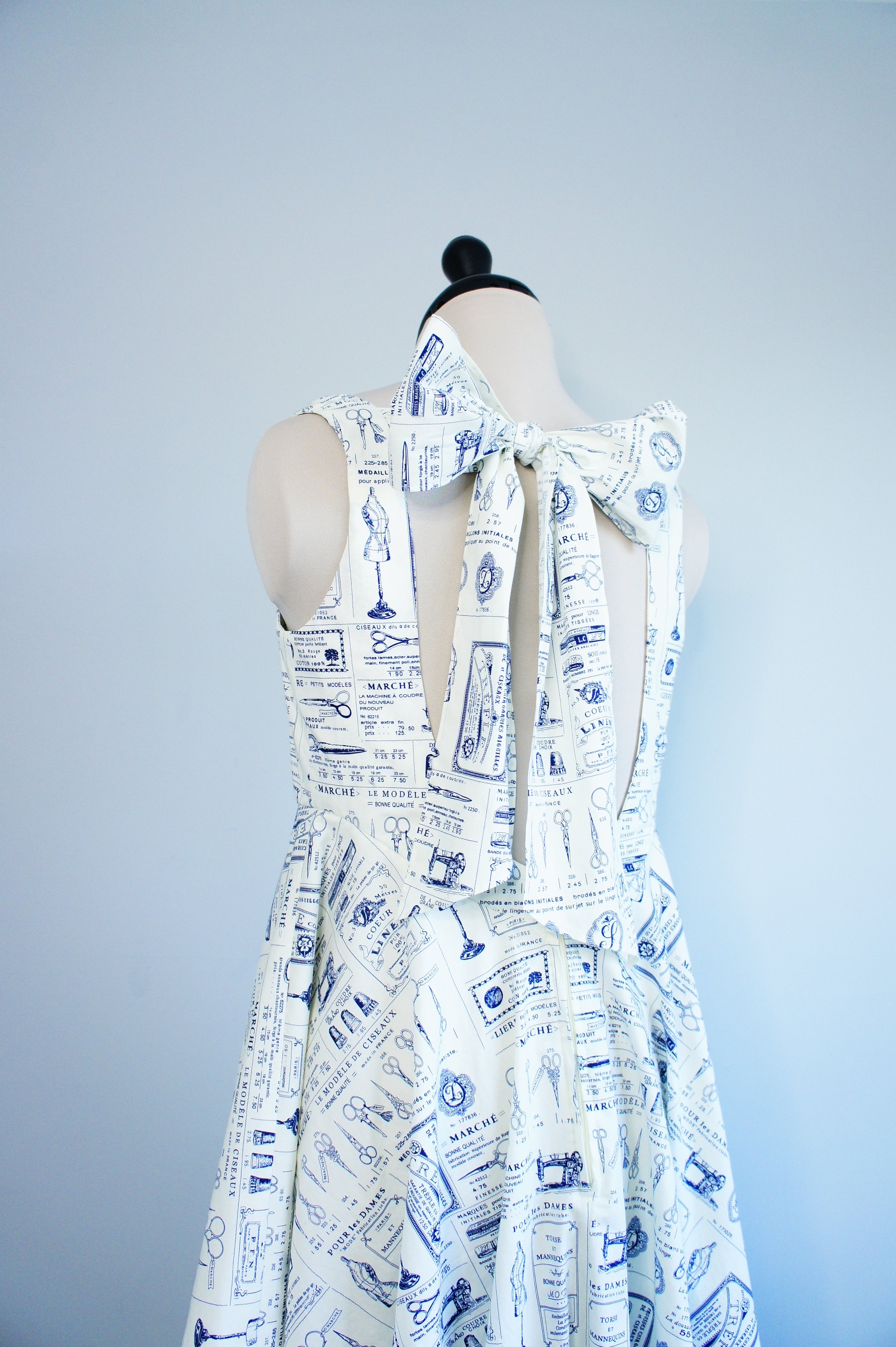
Boat neck summer dress with tie back in a novelty print cotton

Journal of making a dress with boat-neck, shaped underbust seam and large tie bow at the back.

TOTAL TIME COMMITMENT: 10.5 hours without toile (note this dress is unlined)

Cut out & transfer all pattern markings: 2.5 hours

Main construction: 6 hours

Lining construction: none

Finishings (hem): 2 hours


PATTERN CHANGES

None

SEAM FINISHING & DECORATIVE EXTRAS

  • Skirt side seams – French sea

  • Super narrow double-fold hem – beautiful finish


VERDICT & LESSONS LEARNT

The biggest lesson I learnt making this, is that sometimes, an adjustment for my narrow shoulders needs to come from the centre front, to bring both shoulders closer to one another, rather than simply making the shoulder seam itself thinner. The boat neckline of this dress should be ideal on me, but it’s much too wide, meaning the narrow shoulder sections want come in and settle further on my natural shoulder, creating a bunch of excess fabric at the centre neck. I also find that with this fit issue, the armscye is too far over onto my arm, restricting movement. None of this would be fixed by my narrowing, or even sloping the shoulder (common adjustments for me) – instead, this needs a narrowing of the whole neckline, then perhaps adding what I have narrowed, onto the side seam, to keep the overall correct width at the bust and underbust.

This is a full circle skirt and that can create a challenge for cutting out on a fabric which has a print with a very obvious right-way-up, as in this one here


VARIATION IDEAS FOR ANOTHER MAKE

  • Make this in linen, or a linen viscose blend


Travel Itineraries for Summerwear

Read More
Wardrobe, Summer, Dressmaking Frances Lawrence Wardrobe, Summer, Dressmaking Frances Lawrence

A scoop neck tiered sundress from a 1970’s Butterick 7012 pattern

Going off-piste, using quilting cotton for a simple summer tiered dress with topstitching.

TOTAL TIME COMMITMENT: 7.5 hours

Cut out & transfer all pattern markings: 1.5 hours

Main construction: 5.5 hours

Lining construction, attachment and hemming: none

Finishings (hem): 0.5 hours


PATTERN CHANGES

None

SEAM FINISHING & DECORATIVE EXTRAS

  • Vertical interior seams – overlock

  • Raw edges at gathered seam - overlock

  • Attach bodice facing to rest of garment – stitch-in-the-ditch

VERDICT & LESSONS LEARNT

Very very very simple to make. There are hardly any fit devices on this garment (which also means its not very figure-showing either) and there is no closure - it pulls over the head - so it is very easy to knock togther. This looseness of fit makes it ideal for a very very hot day, or as a cover up over a bikini, both of which I have used it for and its ideal.

I absolutely love the Painters Palette solids quilting fabric as an option for dressmaking. It’s so very easy to sew with, and is ‘substantial’ cotton fabric that is not sheer at all. It seems very hard to find a similar weight cotton in true dress-making fabric.

Did a ‘quick and dirty’ Full-Bust-Adjustment on this bodice, that doesn’t have any darts, by simply lengthening the bodice front and back, then adding two darts. Result is not bad, though darts feel like they are in the wrong place.


VARIATION IDEAS FOR ANOTHER MAKE

  • I would like the gathering to be more generous than it is – would like to widen each of the tiers to get more gathering into each one

  • Make in a viscose crepe or a crepe-back satin. The result will be more drapey and the loose fit means seams won’t get stressed.


Other Sewing Projects in Cotton

Read More
Wardrobe, Spring, Dressmaking Frances Lawrence Wardrobe, Spring, Dressmaking Frances Lawrence

A floral needlecord dress from 1970’s Style 1169 pattern

Third make with this pattern, following several refinements on fit and pattern instructions.

TOTAL TIME COMMITMENT: 17.5 hours

Cut out & transfer all pattern markings: 3 hours

Main construction: 12 hours

Lining construction: none

Finishings (buttons, hem): 2.5 hours


ADDITIONAL SEAM FINISHING, CONSTRUCTION NOTES & EXTRAS

  • Vertical interior seams – overlock

  • Raw edges on zip seam – overlock each side separately

  • Raw edges at gathered seam - overlock

  • Attach bodice facing to rest of garment – stitch-in-the-ditch

VERDICT & LESSONS LEARNT

This fine needlecord is surprising substantial, offering a slight bit of warmth for a Northern European spring summer. The length and amount of fabric also contributes to this, making it something I can wear more readily in England, for our temperate climate.  


Travel itineraries for Springwear

Read More